
Executive Summary: AI search visibility measures how often and how favorably AI answer engines (Google AI Overviews, ChatGPT, Perplexity, Gemini, Copilot) cite, mention, or recommend your brand. As zero-click search behavior expands, winning search visibility requires shifting from blue-link rank tracking to Generative Engine Optimization (GEO)—structuring clean, authoritative, machine-readable facts that large language models (LLMs) can extract and attribute.
Key Takeaways
- Beyond Blue Links: AI search visibility evaluates brand presence, inline citations, and product recommendations inside synthesized AI answers, rather than traditional search engine result page (SERP) positions.
- The Zero-Click Impact: Google AI Overviews and conversational answer engines answer user queries directly, reducing traditional click-through rates and making inline AI citations the primary goal [²] [³].
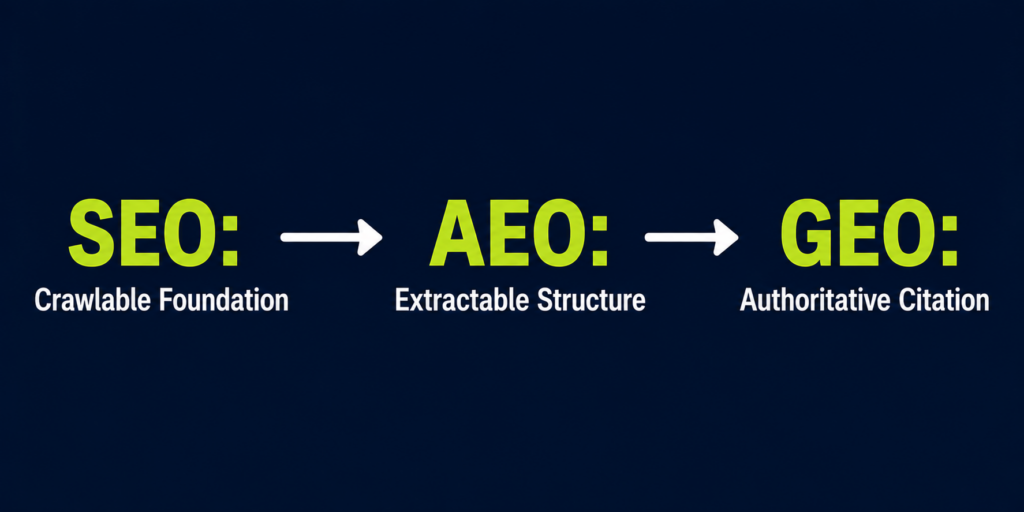
- The Search Continuum: SEO builds the indexable foundation; AEO (Answer Engine Optimization) structures facts for direct extraction; GEO (Generative Engine Optimization) builds the authority required for LLMs to trust and cite your brand.
- Key Index Dependencies: AI answer engines draw heavily from curated data sources: Bing’s search index, Wikipedia, Reddit discussions, and high-authority industry publishers [⁴] [⁵].
- Measurable Share of Voice: AI visibility can be tracked systematically by evaluating Share of AI Voice, prompt citation rates, branded search lift, and AI referral traffic.
What Is AI Search Visibility, Really?
AI Search Visibility is the measure of how frequently, accurately, and prominently an AI answer engine incorporates your brand, products, or published content into its synthesized answers.
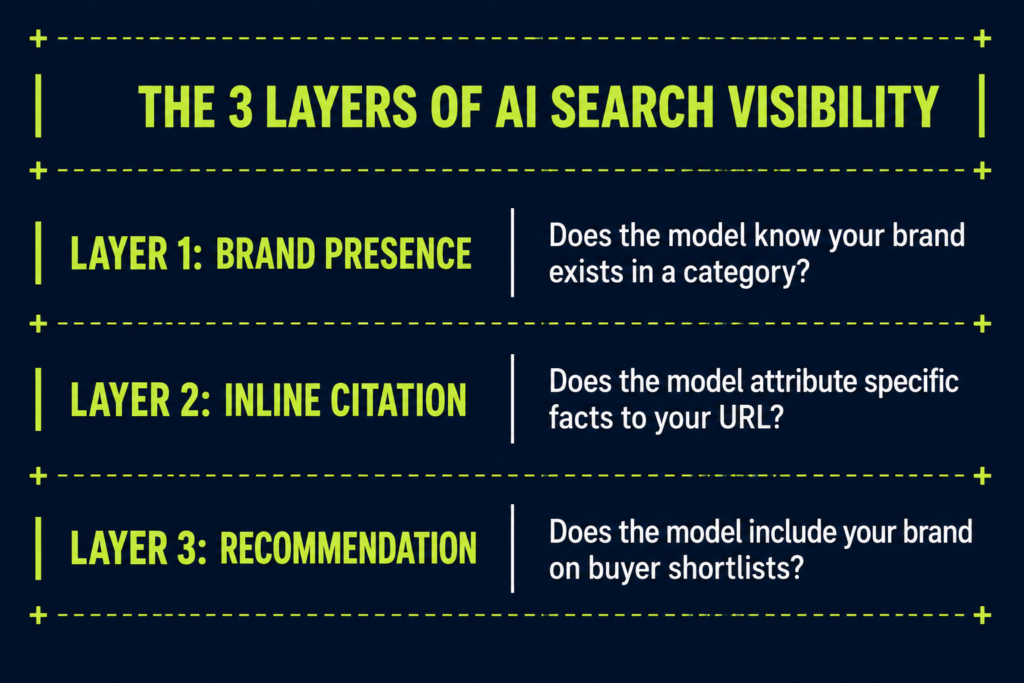
Traditional SEO focuses on single-keyword positions. In contrast, AI search visibility evaluates whether an LLM trusts your domain enough to lift your facts and cite your brand when answering complex, conversational prompts [¹]. A page ranking in position five organically can frequently win the primary AI Overview citation if its content offers a clearer, more extractable direct answer [³].
Why Does AI Search Visibility Matter Now?
Search behavior has shifted permanently from link discovery to direct answer synthesis.
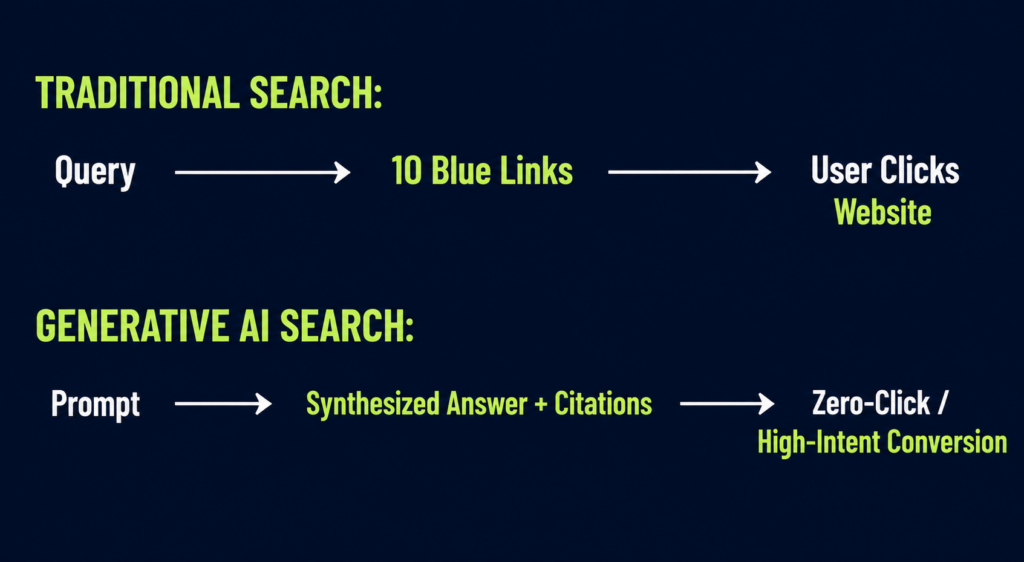
- Expansion of AI Overviews: Google AI Overviews appear across a growing percentage of commercial and informational queries, placing AI-synthesized responses above traditional organic links [³] [⁴].
- The Zero-Click Reality: When AI engines answer questions completely within the interface, users frequently exit without clicking an external link [²]. Earning inline citations ensures brand exposure even during zero-click search sessions [²].
- High-Intent Referral Value: Users who click through an inline AI citation have already reviewed a synthesized summary, converting at significantly higher rates than broad organic traffic [³].
To understand how LLMs evaluate and weight web sources during retrieval, read our guide on What Is Generative Engine Optimization (GEO)?.
How Do GEO and AEO Differ From SEO?
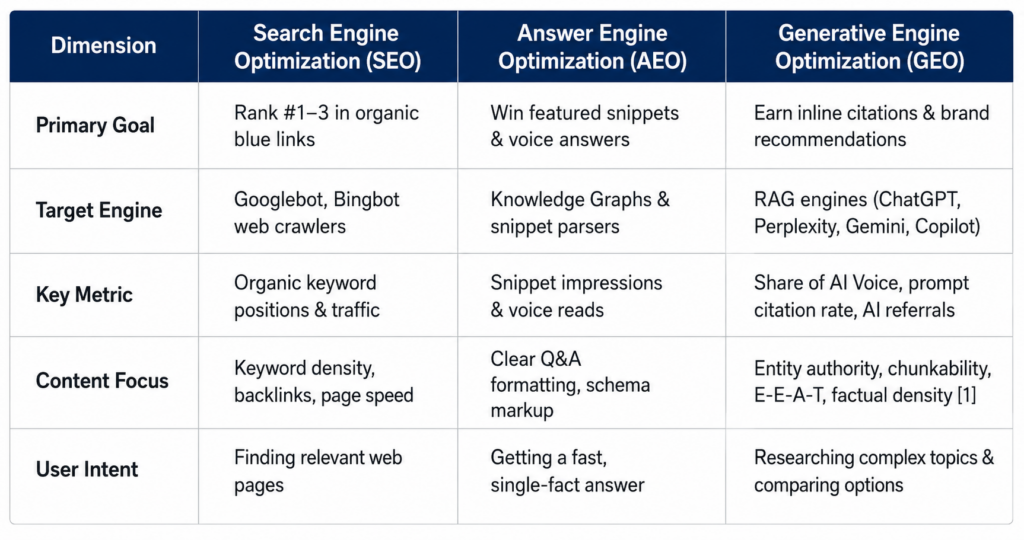
SEO, AEO, and GEO represent an evolving continuum of search optimization strategies rather than isolated disciplines.
Search Discipline Comparison Matrix
What Are the Core Levers of AI Search Visibility?
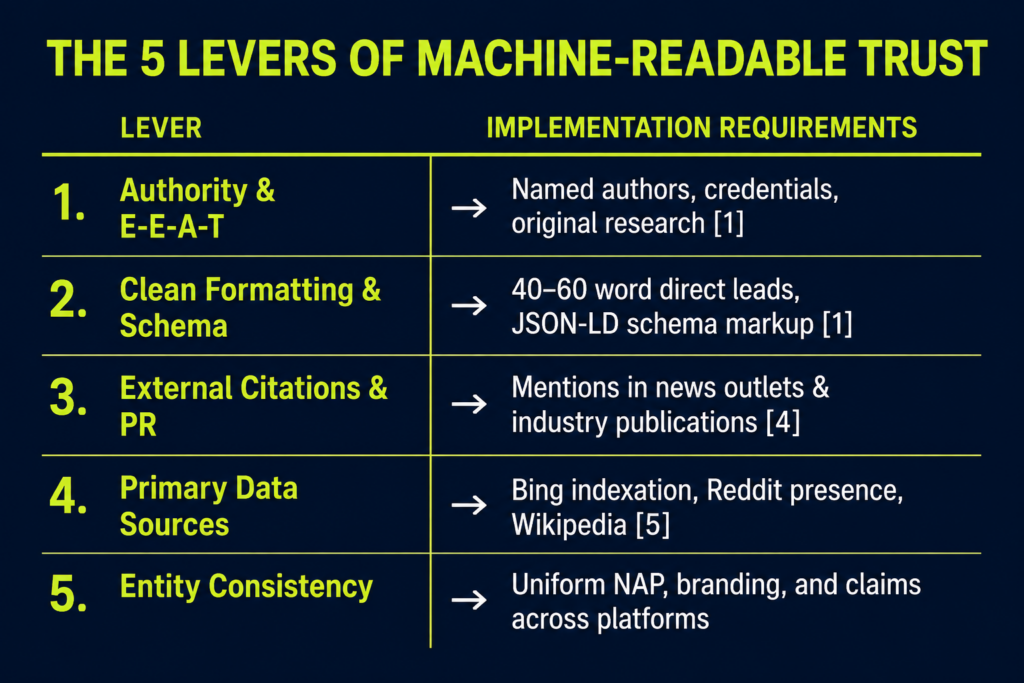
Securing consistent citations across ChatGPT, Perplexity, Google AI Overviews, and Copilot requires optimizing five core trust signals.
1. Authority and E-E-A-T
LLMs are trained to prioritize high-trust sources. Content backed by verified expert authors, first-hand experience, proprietary data, and primary source citations wins retrieval priority over anonymous, generic articles [¹].
2. Structured Data and Clean Extraction
RAG (Retrieval-Augmented Generation) systems parse content in sentence-level chunks. Placing 40-to-60-word direct answers at the beginning of clear subheadings (H2, H3) and implementing JSON-LD schema (Article, FAQPage, Product, Organization) enables seamless machine extraction [¹].
3. Digital PR and External Co-Citations
AI models infer domain authority by analyzing co-citations across the web. Earning brand mentions and backlinks in trusted news outlets, industry trade publications, and authoritative blogs establishes your domain as a primary reference point [⁴].
4. Index Presence Across Primary Source Feeds
AI answer engines draw heavily from specific core indexes:
- Bing Search Index: Powers live web search retrieval for ChatGPT, Microsoft Copilot, and Meta AI [⁵].
- Reddit & Community Forums: Indexed continuously by LLMs for authentic user reviews and peer recommendations [⁴].
- Wikipedia & Wikidata: Serves as a foundational entity grounding layer for Google Knowledge Graphs and LLM training sets [¹].
5. Entity Clarity and Brand Consistency
Discrepancies in your business name, pricing, or product specifications across directories create factual ambiguity, causing AI engines to omit your brand from comparison answers.
How to Measure AI Search Visibility
Evaluating AI search performance requires tracking four core metrics:
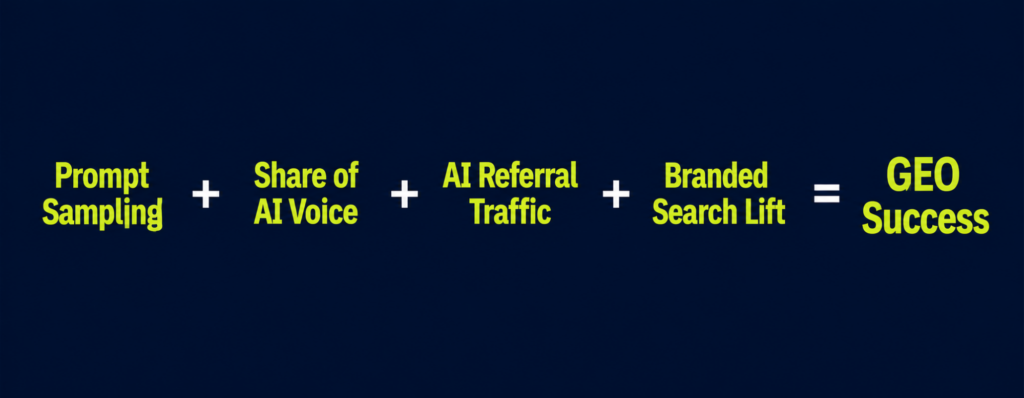
- Prompt Citation Rate: Periodically query ChatGPT, Perplexity, Gemini, and Google AI Overviews with 30 to 50 target customer questions. Track whether your brand is cited, paraphrased, or omitted.
- Share of AI Voice: Calculate the percentage of AI responses within your category that recommend your brand versus key competitors.
- AI Referral Traffic: Create custom channel groupings in GA4 to isolate sessions arriving from chatgpt.com, perplexity.ai, copilot.microsoft.com, and gemini.google.com.
- Branded Search Lift: Monitor increases in direct traffic and branded Google search volume, as users frequently search for brands recommended in zero-click AI answers.
Connecting indirect AI discovery touchpoints to direct orders is why we developed our first-party attribution platform, AdBeacon, giving marketing teams clear revenue attribution without relying on spreadsheet estimates.
5 Antiquated SEO Habits to Stop Immediately
- Habit 1: Chasing Keyword Volume with Thin Content: Writing generic 800-word articles for long-tail keywords fails to earn AI citations. LLMs summarize basic definitions without crediting generic blogs [¹].
- Habit 2: Using Manipulative “Prompt-Stuffing” Gimmicks: Attempting to manipulate LLMs with hidden text or deceptive schema violates quality guidelines and damages domain trust [¹].
- Habit 3: Publishing Anonymous, Author-Less Content: Unverified, faceless articles signal low E-E-A-T, prompting AI models to cite accredited sources instead [¹].
- Habit 4: Ignoring Bing Webmaster Tools: Neglecting Bing indexation cuts your brand off from ChatGPT, Copilot, and Meta AI search layers [⁵].
- Habit 5: Treating GEO as a One-Time Fix: AI models update continuously. Earning and maintaining citations requires an ongoing optimization program [⁴].
Your 90-Day AI Search Visibility Action Plan
Follow this structured roadmap—aligned with our PACE methodology (Plan, Analyze, Convert, Expand)—to build a defensible AI search presence.
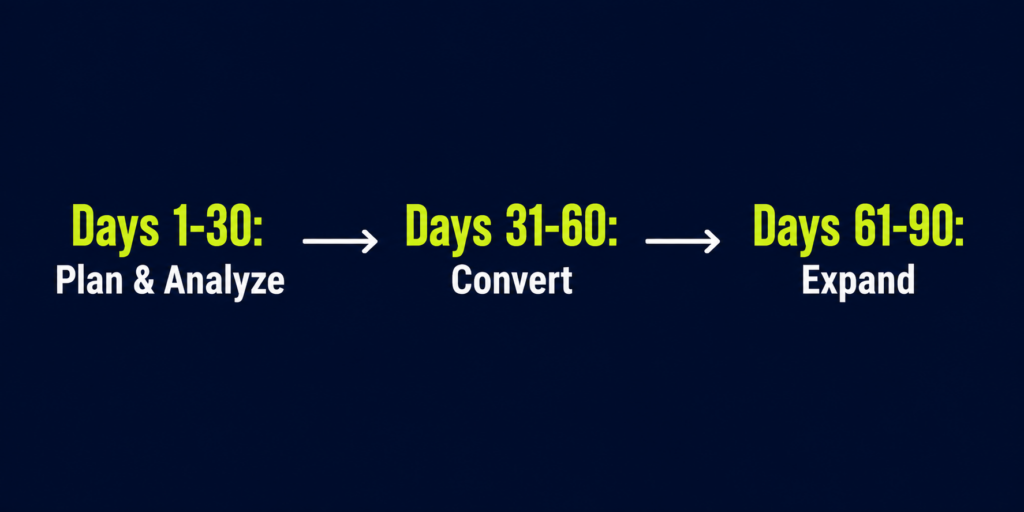
Days 1 to 30: Plan and Analyze (Establish the Baseline)
- Compile 25 to 50 high-intent questions your buyers ask before making a purchase.
- Run prompts across ChatGPT, Google AI Overviews, Perplexity, and Gemini to record your baseline Share of AI Voice.
- Verify domain indexation in Bing Webmaster Tools and inspect robots.txt to ensure OAI-SearchBot and PerplexityBot are allowed [⁵].
- Audit brand entity consistency across your website, Google Business Profile, LinkedIn, and directory listings.
- Build custom GA4 channel groupings to isolate incoming AI referral traffic.
Days 31 to 60: Convert (Optimize Content for Extraction)
- Rewrite top commercial pages to lead with direct, 40-to-60-word answers beneath query-based headings [¹].
- Implement FAQPage, Article, Organization, and Product JSON-LD schema markup.
- Add verified expert author bios, credentials, and original case study metrics to key articles [¹].
- Construct a centralized FAQ hub addressing core category prompts with concise, standalone answers.
- Launch a digital PR push to earn brand citations in authoritative industry publications [⁴].
Days 61 to 90: Expand (Seed Primary Data Sources)
- Establish an active, helpful presence on Reddit and relevant industry forums where target queries are discussed [⁴].
- Publish proprietary research, survey data, or industry benchmarks to function as an un-copyable primary source [¹].
- Re-test your 25–50 baseline buyer prompts to measure Share of AI Voice growth and refine underperforming pages.
- Establish a monthly reporting cadence to track ongoing citation visibility.
If executing this roadmap requires dedicated technical support, our specialized AI Search Optimization team provides end-to-end implementation for e-commerce and B2B brands.
Partner with National Positions for Data-Driven GEO
Winning citations across ChatGPT, Perplexity, Google AI Overviews, and Copilot requires integrated analytics engineering, digital PR, and technical content structuring.
National Positions provides complete Generative Engine Optimization solutions:
- 22+ Years of Search Engine Leadership: Managing digital search and performance analytics for over 300 e-commerce and B2B brands.
- Google Premier Partner Leadership: Recognized in the top tier of performance marketing agencies globally.
- The PACE Framework: Our methodology (Plan, Analyze, Convert, Expand) grounds AI search strategies in verified revenue metrics.
- First-Party Attribution via AdBeacon: Our proprietary first-party attribution platform, AdBeacon, measures multi-touch discovery across organic, paid, and AI-driven channels.
Ready to audit your brand’s AI search visibility? Book a call with our team to evaluate your current citation baseline and build a platform-specific GEO strategy.
Frequently Asked Questions
Is AI search visibility replacing traditional SEO?
No, GEO extends traditional SEO. AI engines rely on traditional search crawlers to index web content [¹] [⁵]. Solid technical SEO, crawlability, and domain authority form the mandatory foundation for winning AI citations.
How does AI search visibility differ from ranking #1 on Google?
Organic rankings measure position within a list of web links. AI search visibility measures whether an AI engine incorporates your brand, quotes your text, or links your domain within a synthesized conversational answer [¹] [³].
Which AI search engines should brands prioritize first?
Prioritize Google AI Overviews, ChatGPT, Perplexity, and Microsoft Copilot [³] [⁵]. Google provides massive consumer reach, ChatGPT and Perplexity capture active research intent, and Copilot covers enterprise workplace queries [⁵].
How long does it take to see measurable results from GEO?
Directional improvements in citation frequency can appear within 30 to 60 days following structural lead-paragraph edits, schema updates, and Bing indexation fixes [¹] [⁵]. Compounding authority gains from digital PR and primary research accrue over 6 to 12 months [⁴].
Do businesses still need traditional SEO if they invest in GEO?
Yes. Without foundational SEO (crawlable pages, indexation, clean architecture), AI crawlers cannot access or trust your content [¹] [⁵]. SEO and GEO must operate as a single unified program.
Sources & References
- Google Search Central, “Guidance on AI Overviews, Helpful Content, and E-E-A-T Frameworks,” Technical Webmaster Guidelines [¹].
- Pew Research Center, “Search Engine User Behaviors and the Expansion of Zero-Click Search Sessions,” Digital Media Research Reports [²].
- Semrush, “AI Overview Occurrence Rates, Citation Volatility, and Referral Traffic Benchmarks,” Industry Search Analytics (2025–2026) [³].
- Search Engine Land, “Generative Engine Optimization (GEO) Benchmarks and Multi-Engine Citation Analysis,” Industry Reporting [⁴].
- Microsoft Bing Webmaster Documentation, “Bing Web Indexing Architecture and Retrieval Roles in Generative AI Search,” Technical Documentation [⁵].