
Executive Summary: Amazon retired its Rufus chat assistant in May 2026, integrating its generative intelligence into Alexa for Shopping on the Alexa+ platform [¹]. Equipped with autonomous “Buy for Me” agentic capabilities, Alexa can evaluate products and execute purchases across Amazon and third-party retail sites [¹]. Generative Engine Optimization (GEO) for Amazon requires shifting from human persuasion copy to machine-readable trust signals: structured catalog data, review velocity, Q&A depth, and price/inventory stability.
Key Takeaways
- The Transition from Rufus to Alexa: Amazon retired Rufus as a standalone chat tool and folded its capabilities into Alexa for Shopping across the Amazon Shopping app, amazon.com, and Echo Show devices [¹].
- The Rise of Autonomous “Buy for Me”: The “Buy for Me” feature enables Alexa to execute transactions directly using saved user payment details, purchase history, and automated price-tracking signals [¹].
- Third-Party Retail Expansion: Amazon offers its agentic shopping technology to external retailers via AWS, making agentic commerce an industry-wide standard [²].
- The Death of the Traditional Funnel: When an AI agent buys autonomously, traditional persuasion triggers (hero imagery, sales headlines) sit downstream of machine-readable data filters [³].
- Core Machine-Readable Signals: Autonomous buying agents rank products based on structured attribute completeness, review recency/velocity, Q&A depth, price/Buy Box stability, and Subscribe & Save eligibility [³].
What Happened to Rufus, and Why Does It Matter Now?
In May 2026, Amazon retired Rufus as a standalone conversational app feature and integrated its underlying shopping intelligence directly into Alexa for Shopping via the Alexa+ platform [¹].
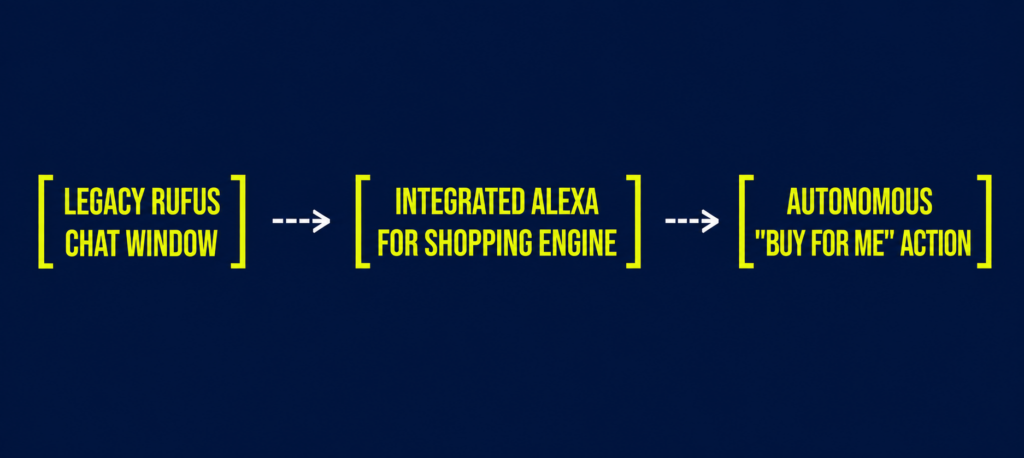
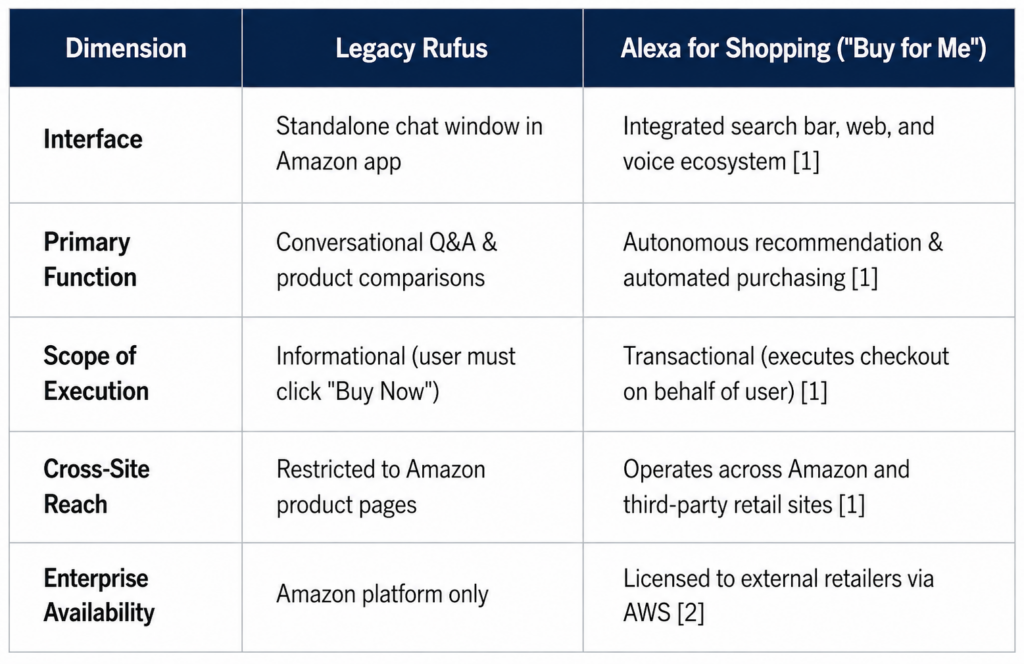
Available across the Amazon Shopping app, desktop site, and Echo Show hardware, Alexa for Shopping eliminates the friction of opening a separate chat window [¹]. Shopping assistance now lives natively inside search bars and voice interfaces without requiring Prime membership or Echo hardware [¹].
Rufus vs. Alexa for Shopping (“Buy for Me”)
What Is “Buy for Me,” and Why Is It a Strategic Shift?
“Buy for Me” is the autonomous purchasing engine embedded within Alexa for Shopping [¹]. It uses saved customer payment credentials, shipping addresses, historical order patterns, and browsing habits to compare items, track price drops, set up recurring deliveries, and check out without requiring the human user to visit a product detail page [¹].
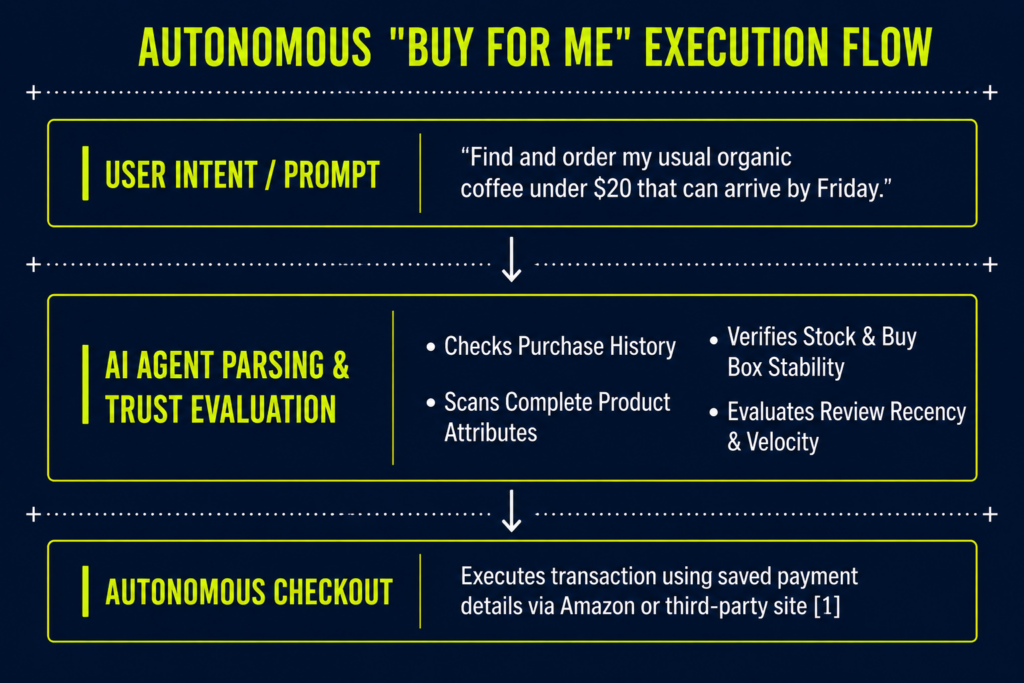
Amazon’s licensing of this agentic architecture to third-party retailers via AWS indicates that autonomous purchasing is becoming an e-commerce-wide standard [²]. For a broader perspective on how autonomous agents operate across web platforms, read our analysis on AI Search Engines Compared.
Why Machine-Readable Trust Replaces the “Click”
Traditional e-commerce conversion optimization follows a linear human funnel: Impression

Autonomous agents eliminate the middle steps of this funnel. An AI agent parses raw product data, evaluates constraint parameters (“fits under an 18-inch cabinet”), checks stock stability, and executes the transaction [³].
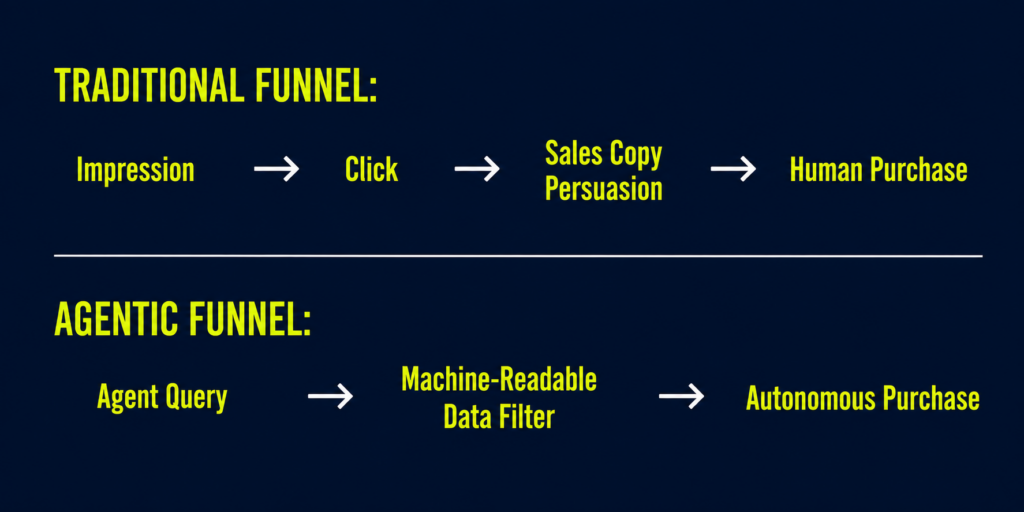
When an AI agent makes the purchasing decision, brand voice and persuasive sales copy sit downstream of literal data filters. If an AI agent cannot verify a critical product attribute, it passes over the listing in favor of a competitor with complete, structured data [³].
What Does an Autonomous Buying Agent Actually Weigh?
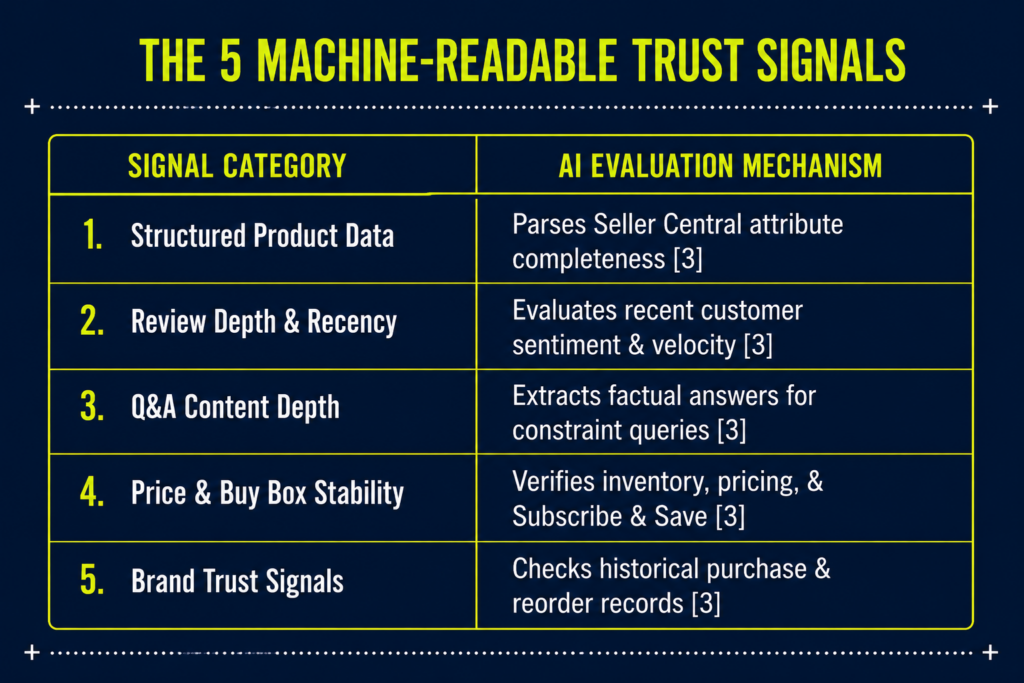
Alexa for Shopping and similar agentic systems evaluate five primary categories of machine-readable signals [³].
1. Structured Product Data Completeness
Empty attribute fields in Seller Central represent missing information for the AI assistant [³]. Complete fields for dimensions, materials, power consumption, compatibility, and specific use cases supply the raw data needed for constraint-based comparisons [³].
- Bullet Point Formatting: Lead with explicit technical facts followed by practical benefits. Keyword-stuffed bullet points create semantic noise that impairs accurate information extraction by LLM parsers [³].
2. Review Depth and Recency
AI engines synthesize customer reviews to construct product overviews and answer follow-up queries [³]. Review recency signals ongoing product quality, active inventory, and buyer satisfaction [³]. A product with 400 reviews accumulated over the last 90 days often ranks above a product with 4,000 stale reviews from three years ago [³].
3. Technical Q&A Content
The Customer Questions & Answers section provides direct conversational text that generative engines lift to answer specific user prompts [³]. Maintaining an active, documented Q&A section prevents the AI assistant from substituting data from a competitor’s listing [³].
4. Price, Buy Box, and Inventory Stability
Autonomous checkout agents require verified pricing accuracy and active inventory states prior to executing transactions [³]. Frequent out-of-stock events, Buy Box instability, or missing Subscribe & Save enrollment create operational friction that leads AI agents to select alternative sellers [³].
5. Historical Brand Trust Signals
Prior purchase history and historical order patterns heavily influence AI recommendations [³]. Established brands with recurring customer order histories possess a structural advantage [³]. Maintaining high Subscribe & Save retention rates strengthens this signal.
5 Antiquated Habits to Stop Immediately
- Keyword-Stuffing Bullet Points: Overloading bullet points with repeated keyword variations degrades LLM parsing accuracy [³]. State facts clearly and concisely.
- Treating A+ Content as Purely Visual Imagery: Image-heavy A+ content without structured text, spec comparison tables, and usage documentation provides no extractable data for AI engines [³].
- Allowing Review Acquisition to Laps After Launch: Discontinuing review generation efforts after product launches creates a recency deficit that hurts AI recommendation scores [³].
- Leaving Seller Central Attribute Fields Blank: Treating optional backend fields as unnecessary paperwork excludes your listings from filtered AI comparison queries [³].
- Ignoring Product Q&A Management: Leaving customer questions unanswered allows AI assistants to pull answers from competing brand listings [³].
Your 30-Day Alexa for Shopping Optimization Plan
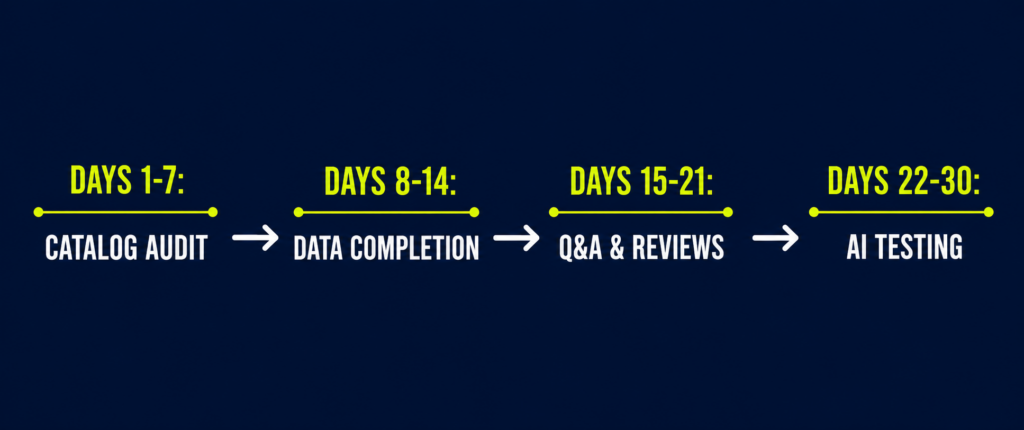
Days 1 to 7: Audit Top SKUs Against Trust Signals
- Select your top 20 to 30 revenue-generating SKUs.
- Audit each listing for backend attribute completeness, review recency (reviews within the last 90 days), Q&A coverage, Buy Box ownership stability, and Subscribe & Save eligibility [³].
Days 8 to 14: Complete Structured Backend Data
- Log into Seller Central and populate all vacant attribute fields for target SKUs [³].
- Rewrite product bullet points: state the core technical specification first, followed by the buyer benefit [³].
Days 15 to 21: Expand Q&A Coverage and Review Cadence
- Populate your listing Q&A section using real customer support tickets and recurring inquiry data [³].
- Restart compliant post-purchase review request workflows to establish continuous review velocity [³].
Days 22 to 30: Test AI Agent Outputs Directly
- Query Alexa for Shopping using category comparison prompts (e.g., “What is the best energy-efficient countertop blender under $150?”).
- Document whether your product is recommended, analyze competitor positioning, and address missing product attributes revealed in AI outputs [³].
If your Amazon catalog requires a comprehensive technical review, our Amazon marketing team provides specialized Amazon catalog and data audits for high-volume brands.
Partner with National Positions for Advanced Amazon GEO
Optimizing product catalogs for autonomous AI buying requires structured data management, inventory stability, and cross-platform analytics integration.
National Positions provides comprehensive Amazon and performance marketing solutions:
- 22+ Years of Growth Analytics: Managing and scaling digital marketplace operations for over 300 e-commerce and SMB brands.
- Google Premier Partner Leadership: Recognized in the top tier of digital performance agencies worldwide.
- The PACE Framework: Our integrated framework (Plan, Analyze, Convert, Expand) grounds catalog optimization in verified business revenue.
- First-Party Attribution via AdBeacon: Our proprietary first-party attribution platform, AdBeacon, tracks multi-touch buyer journeys across paid, organic, and AI discovery channels.
Ready to evaluate your Amazon catalog against Alexa for Shopping’s trust algorithms? Book a call with our team to request an Amazon catalog audit and build a platform-specific GEO strategy.
Frequently Asked Questions
What replaced Amazon Rufus?
Amazon retired Rufus as a standalone chat assistant in May 2026 and integrated its shopping capabilities directly into Alexa for Shopping on the Alexa+ platform [¹]. It is accessible across the Amazon Shopping app, desktop site, and Echo Show devices without requiring Prime membership or Echo hardware [¹].
What is “Buy for Me” and how does it impact sellers?
“Buy for Me” is an autonomous purchasing feature within Alexa for Shopping that executes transactions across Amazon and third-party retail websites using saved customer payment details, address data, and purchase histories [¹]. Sellers must supply clean, machine-readable catalog data to earn recommendations and autonomous purchases [³].
Should e-commerce brands rewrite all Amazon product listings at once?
Focus initially on your top 20 to 30 revenue-generating SKUs. Complete backend attributes, update bullet points for readability, build Q&A depth, and establish review velocity on core products before expanding optimizations across your catalog [³].
Does Alexa for Shopping favor established brands over new market entrants?
Alexa for Shopping factors historical purchase data and reorder patterns into its recommendation engine, providing an advantage to established products [³]. Newer brands can offset this gap by maintaining complete backend attribute data, high review recency, and detailed Q&A content [³].
How does Amazon GEO differ from traditional Amazon SEO?
Traditional Amazon SEO optimizes keyword density and search index placement to rank listings on keyword search result pages. Amazon GEO optimizes structured attributes, review recency, and Q&A depth so generative AI assistants can confidently extract, compare, and execute purchases [³].
How can sellers track whether Alexa for Shopping is recommending their products?
Sellers can query Alexa for Shopping directly using category-level prompts and document returned product recommendations [³]. Track performance across key AI search engines using the methods outlined in our guide on tracking AI search visibility across platforms.
Sources & References
- Amazon News, “Amazon Retires Rufus, Launches Alexa for Shopping and Cross-Retailer ‘Buy for Me’ Feature,” [¹].
- AWS Enterprise Announcements, “Licensing Agentic Shopping Architectures for Multi-Retailer Deployment via AWS,” Amazon Web Services Technical Disclosures (2026) [²].
- E-Commerce GEO Analytics, “Optimizing Amazon Product Catalogs for Generative AI and Autonomous Buying Agents,” Seller Central Data & Trust Signal Benchmarks (2026) [³].