
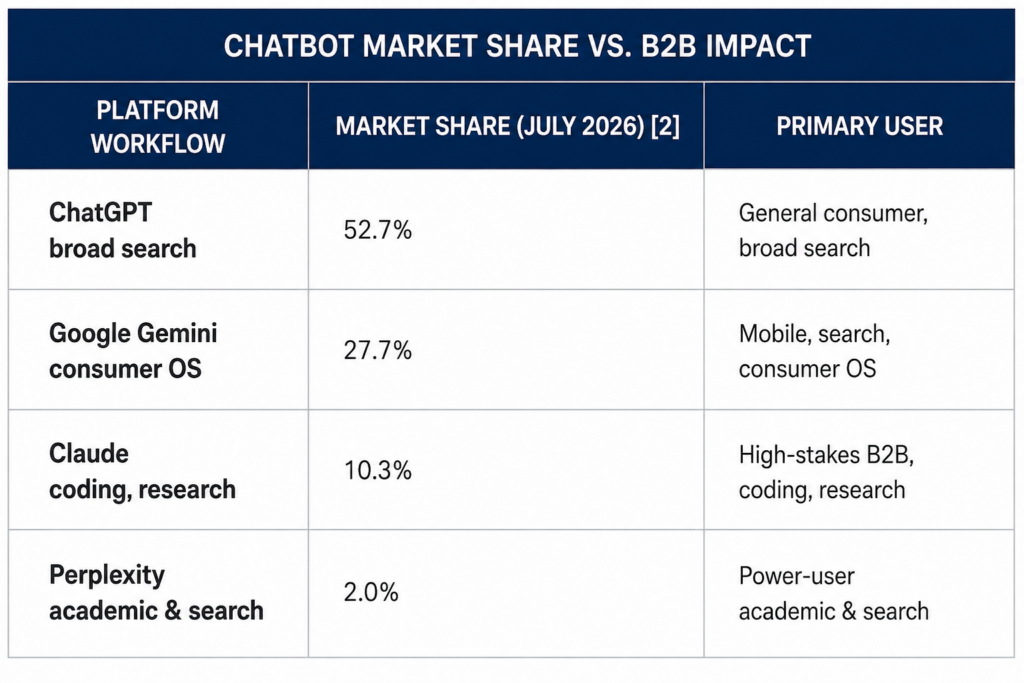
Executive Summary: Claude employs a decision-driven web search layer and a native Citations API that parses web pages into sentence-level chunks, attaching exact quoted passages (up to 150 characters), URLs, and page titles to its claims [¹]. While holding roughly 10.3% of the consumer chatbot market [²], Claude is heavily utilized across B2B, technical, and enterprise research workflows [³]. Winning citations in Claude requires managing Anthropic’s three distinct web crawlers (ClaudeBot, Claude-User, Claude-SearchBot), maintaining structured “chunkable” content, and managing the page_age freshness signal.
Key Takeaways
- High-Stakes Audience: While ChatGPT leads consumer volume, Claude accounts for a significant portion of developer, enterprise, and B2B vendor evaluation workflows [²] [³].
- Sentence-Level Chunking: Anthropic’s Citations API decomposes source HTML into sentence-level fragments. Clear, standalone claims improve recall accuracy by up to 15% and virtually eliminate hallucinations [¹].
- The 3-Crawler Distinction: Blocking ClaudeBot in robots.txt stops AI training usage, but mistakenly blocking Claude-User or Claude-SearchBot removes your site from live search retrieval and citations.
- The page_age Signal: Claude’s search tool explicitly evaluates page recency metadata. Stale pages risk being omitted during live search reasoning passes.
- B2B Decision Influence: B2B buyers, procurement analysts, and agencies rely heavily on Claude for market monitoring, vendor comparisons, and lead qualification workflows [³].
Why Everyone Ignores Claude in GEO Strategy (and Why That’s a Mistake)
Generative Engine Optimization (GEO) playbooks frequently focus on consumer search volume, prioritizing ChatGPT and Google AI Overviews. However, evaluating AI platforms purely by consumer market share misses where high-value purchasing decisions occur.
The Professional Usage Skew
Anthropic’s Economic Index highlights Claude’s orientation toward professional, high-stakes tasks [³]:
- Technical Work: Coding and technical architecture tasks account for approximately 35% of conversations on Claude.ai [³].
- Enterprise API Growth: API usage is concentrated in business operations, including sales enablement, lead qualification, customer data enrichment, and competitive market monitoring [³].
- High-Value Touchpoints: B2B buyers and procurement teams use Claude to draft vendor shortlists, evaluate software platforms, and summarize complex industry reports.
Ignoring Claude because it lacks consumer trivia volume means missing the primary AI assistant used during high-value vendor evaluations.
Is Claude Actually a Search Engine?
Claude does not operate as a traditional search engine with a dedicated query box. Instead, it utilizes a decision-driven web search tool that autonomously determines when live external web data is required to answer a prompt.
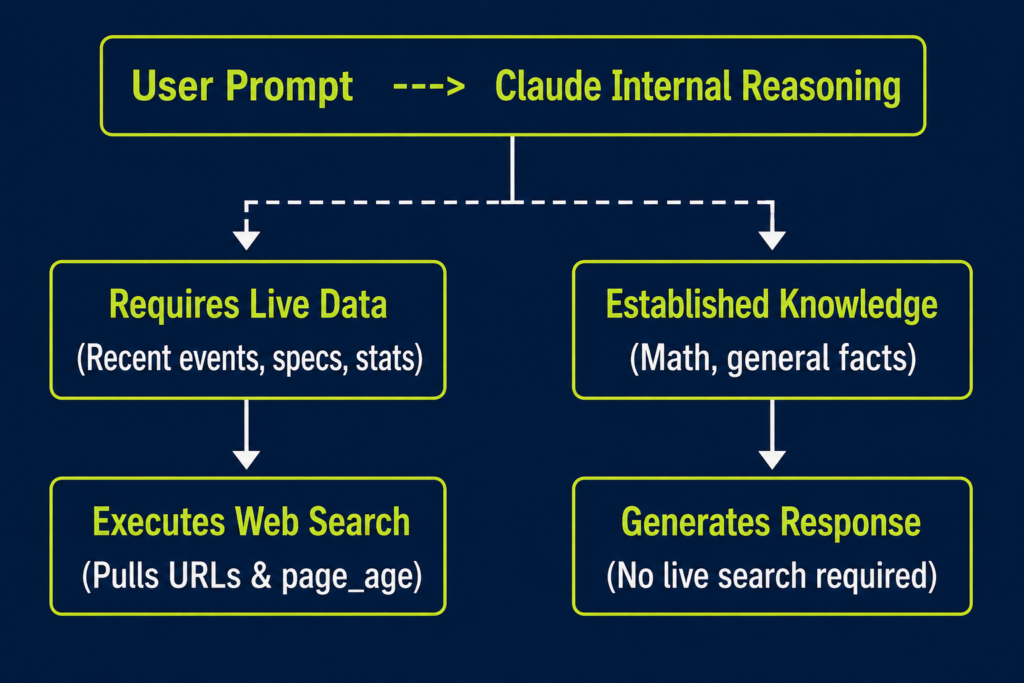
Key Retrieval Mechanics:
- Autonomous Search Triggering: Claude initiates a web search when a query involves current statistics, breaking news, market pricing, or specific product specifications that may have changed since model training.
- The page_age Metadata Signal: Search results retrieved by Claude include a page_age field. Pages that have not been updated risk being marked as outdated during Claude’s verification process.
- Custom Domain Governance: Enterprise clients utilizing Claude via API can configure explicit domain blocklists or allowlists. Winning citations requires building domain authority that enterprise researchers trust by default.
How Does Claude Decide What to Cite? (Inside the Citations API)
Anthropic’s Citations API governs how Claude extracts and credits web source material [¹].
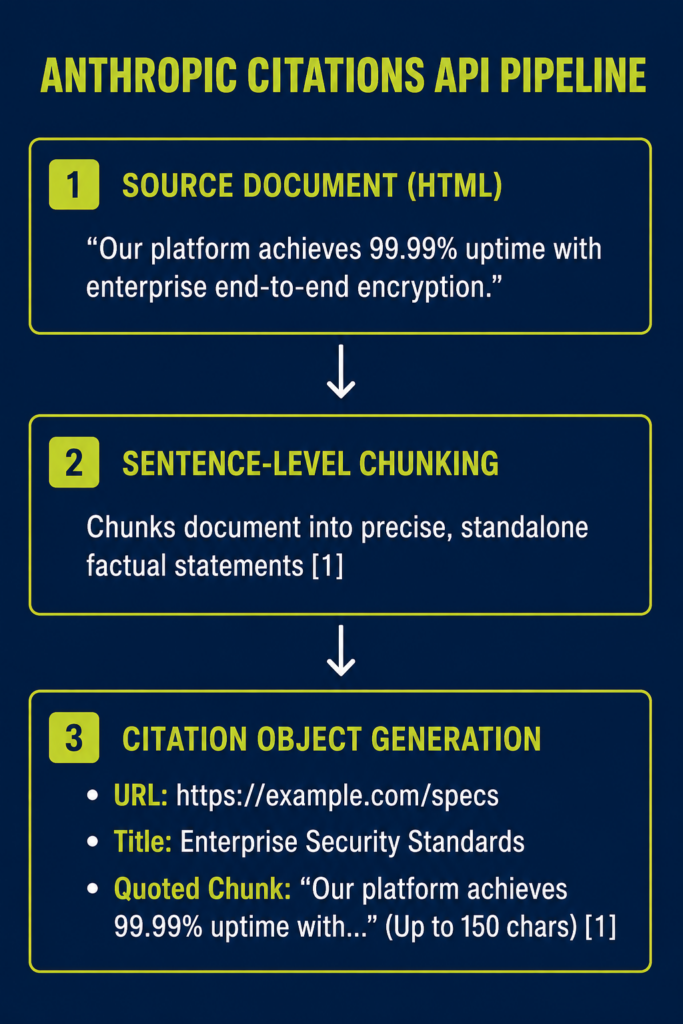
How Chunking Affects GEO Strategy:
- Recall Accuracy: Anthropic reports that built-in, chunk-level citations improve answer recall accuracy by up to 15% compared to standard RAG setups, reducing hallucination rates to near zero [¹].
- Standalone Claim Structure: Claude evaluates claims by matching them directly to sentence-level chunks. Vague, buried, or multi-paragraph arguments do not chunk cleanly. Concise, self-contained, data-backed statements are easily extracted and cited [¹].
What Is ClaudeBot, and Should You Block It?
Anthropic operates three distinct web crawlers. Misconfiguring robots.txt by combining these user-agents is a common technical issue that can unintentionally erase a site’s visibility in Claude’s search answers.
Anthropic Crawler Directives Table
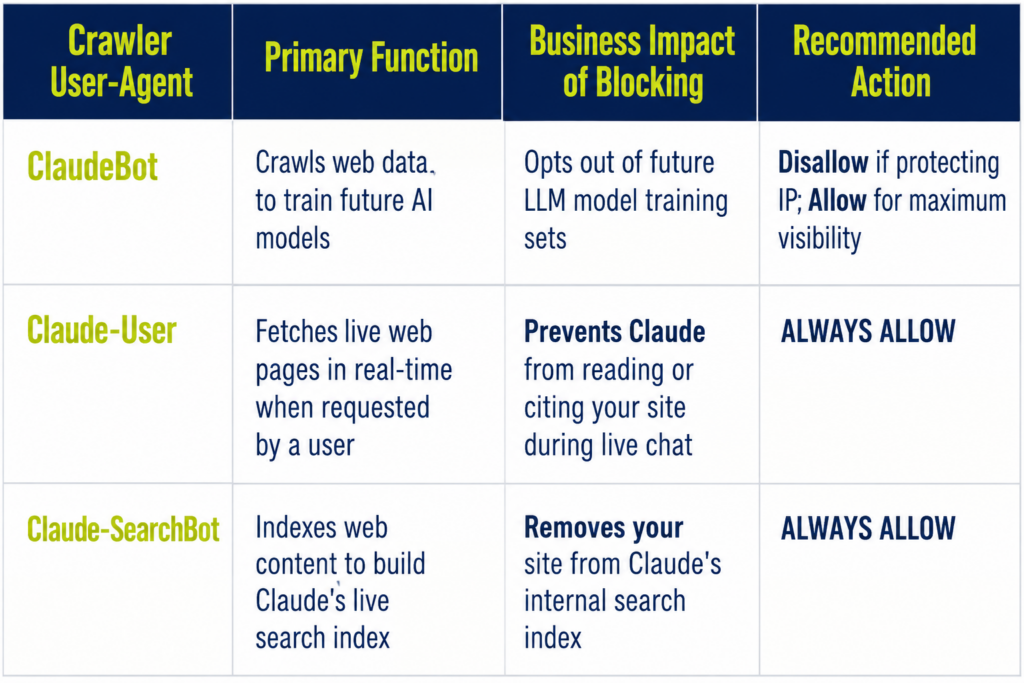
Approximately 36% of top web publishers block ClaudeBot using blanket rules that unintentionally block Claude-User and Claude-SearchBot as well.
Recommended robots.txt Configuration:
To opt out of AI model training while remaining fully eligible for live search retrieval and citations, configure your robots.txt as follows:
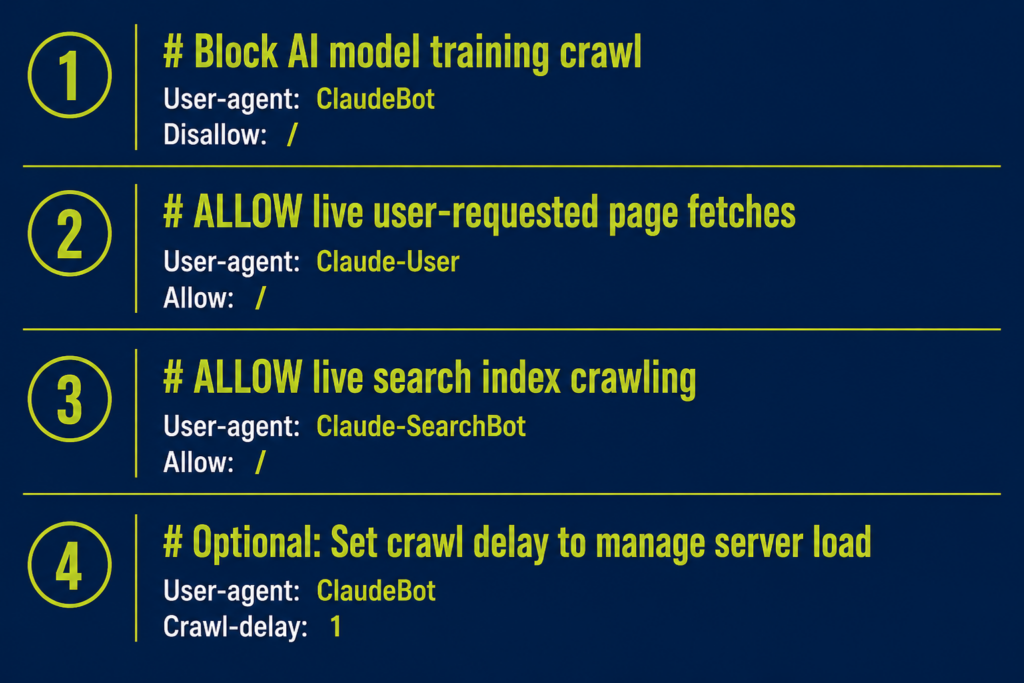
Note: Verify IP ranges using Anthropic’s public bots.json endpoint to ensure firewall rules do not accidentally block legitimate Claude crawlers.
5 Common GEO Practices That Fail on Claude
- Mistake 1: Using Blanket Disallow: / Rules for All AI Bots: Blocking all AI crawlers inadvertently disables Claude-User, preventing Claude from accessing your site during live user queries.
- Mistake 2: Burying Key Data Below Long Introductions: Placing primary statistics or product specifications deep within a page makes it harder for the Citations API to extract clean, sentence-level chunks [¹].
- Mistake 3: Relying on Stale Technical Content: Failing to update publication dates and core specifications causes the page_age signal to flag content as outdated during search retrieval.
- Mistake 4: Writing Vague, Non-Specific Claims: Broad assertions like “we are a leading software provider” fail to chunk effectively. Use precise, verifiable statements like “our software integrates with 45 CRM platforms via REST API.”
- Mistake 5: Ignoring B2B Query Intent: Optimizing solely for high-volume consumer queries neglects the technical, high-intent research prompts commonly run on Claude [³].
Your 30-Day Claude Visibility Implementation Plan
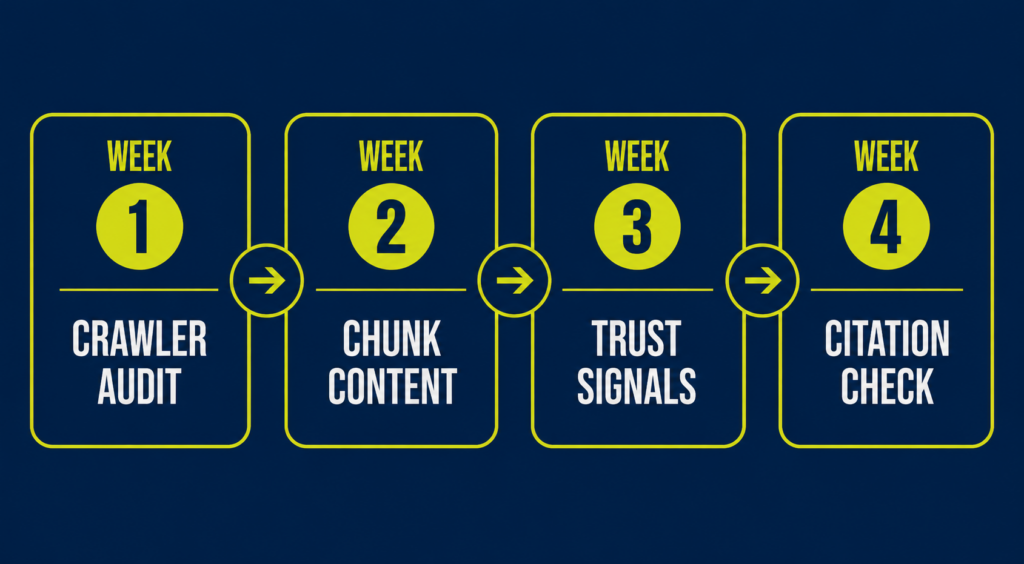
Week 1: Audit Robot Directives and Server Logs
- Inspect your server robots.txt file to verify that Claude-User and Claude-SearchBot are explicitly allowed.
- Review server access logs to confirm that Anthropic IP ranges are not blocked by web application firewalls (WAF).
Week 2: Optimize Key Pages for Sentence-Level Chunking
- Select your top 10 B2B service, comparison, or product specification pages.
- Rewrite lead paragraphs to state primary facts, pricing, specs, or statistics within the first two sentences.
- Ensure every key claim functions as a complete, standalone statement that makes sense out of context [¹].
Week 3: Update Freshness and Schema Markup
- Update dateModified schema tags and refresh core stats across key pages to improve the page_age signal.
- Implement structured Organization, Product, and TechArticle JSON-LD schema markup.
- Publish original, data-backed case studies that supply unique, citable facts [¹].
Week 4: Verify Live Citations and Monitor Visibility
- Prompt Claude directly with 15 to 20 realistic B2B buyer questions (e.g., “Compare the top enterprise attribution platforms for B2B SaaS”).
- Inspect returned citations to verify whether your URLs, page titles, and quoted text appear in the output [¹].
- Track multi-platform AI visibility using the frameworks outlined in our guide to tracking AI search visibility across platforms.
If your business needs a comprehensive technical audit across AI crawler networks, our specialized AI search optimization work provides end-to-end implementation for e-commerce and B2B brands.
Partner with National Positions for B2B Generative Optimization
Earning consistent citations across Claude, ChatGPT, Perplexity, and Google AI Overviews requires technical crawler management, structured data architecture, and clear content engineering.
National Positions delivers complete Generative Engine Optimization solutions:
- 22+ Years of Growth Engineering: Managing search and performance analytics for over 300 e-commerce and B2B brands.
- Google Premier Partner Leadership: Recognized in the top tier of performance marketing agencies globally.
- The PACE Framework: Our methodology (Plan, Analyze, Convert, Expand) grounds AI search optimization in verifiable business revenue.
- First-Party Attribution via AdBeacon: Our proprietary first-party attribution platform, AdBeacon, measures traffic and conversion impact across paid, organic, and AI-driven channels.
Ready to audit how your brand appears across Claude and other generative search engines? Talk to National Positions to evaluate your current GEO baseline and build a platform-specific citation strategy.
Frequently Asked Questions
Is Claude a standalone search engine?
No. Claude is an AI assistant that uses a decision-driven web search tool. It executes live web searches when queries require current facts, real-time data, or specific product details [¹].
What is the difference between ClaudeBot and Claude-User?
ClaudeBot crawls the web to collect training data for future Anthropic models. Claude-User fetches web pages in real-time when a user asks Claude a question during an active conversation. Blocking Claude-User prevents Claude from reading or citing your site [¹].
How does Anthropic’s Citations API generate citations?
The Citations API parses source HTML into sentence-level chunks, matches relevant chunks to user prompts, and appends a citation object containing the source URL, page title, and a quoted passage (up to 150 characters) [¹].
Will blocking ClaudeBot harm my traditional Google SEO rankings?
No. Blocking ClaudeBot only impacts Anthropic’s crawlers and does not affect Googlebot or traditional Google search rankings. However, blocking Claude-SearchBot or Claude-User will prevent your site from appearing in Claude’s search results and citations.
How can a B2B brand optimize content for Claude’s chunking mechanism?
Lead with clear, self-contained factual claims in the opening sentences of key sections. State specific metrics, features, or specifications clearly so the Citations API can extract clean 150-character chunks [¹].
Is optimizing for Claude worth the effort given its market share?
Yes. Claude holds 10.3% of the chatbot market [²], with heavy usage among enterprise, developer, and B2B research users [³]. Influencing buyer shortlists during high-stakes vendor evaluations yields significant commercial value.
Sources & References
- Claude, “Citations API Mechanics and Document Chunking Architecture,” Anthropic Developer Docs [¹].
- First Page Sage, “AI Chatbot Market Share & Usage Report,” Monthly Industry Analytics [²].
- Ez Intagrations, “Enterprise API Usage Patterns and Workflow Categorization,” Economic Impact Disclosures (March 2026) [³].
Related Deep-Dive Guides
- Multi-Engine Strategy: Read AI Search Engines Compared to see how Claude compares against ChatGPT, Perplexity, and Gemini.
- Google’s Ecosystem: Read Gemini in Search versus the Gemini App to master Google’s generative search interfaces.
- AI Visibility Analytics: Read How to Track AI Search Visibility Across Platforms to measure brand citations across major AI engines.