
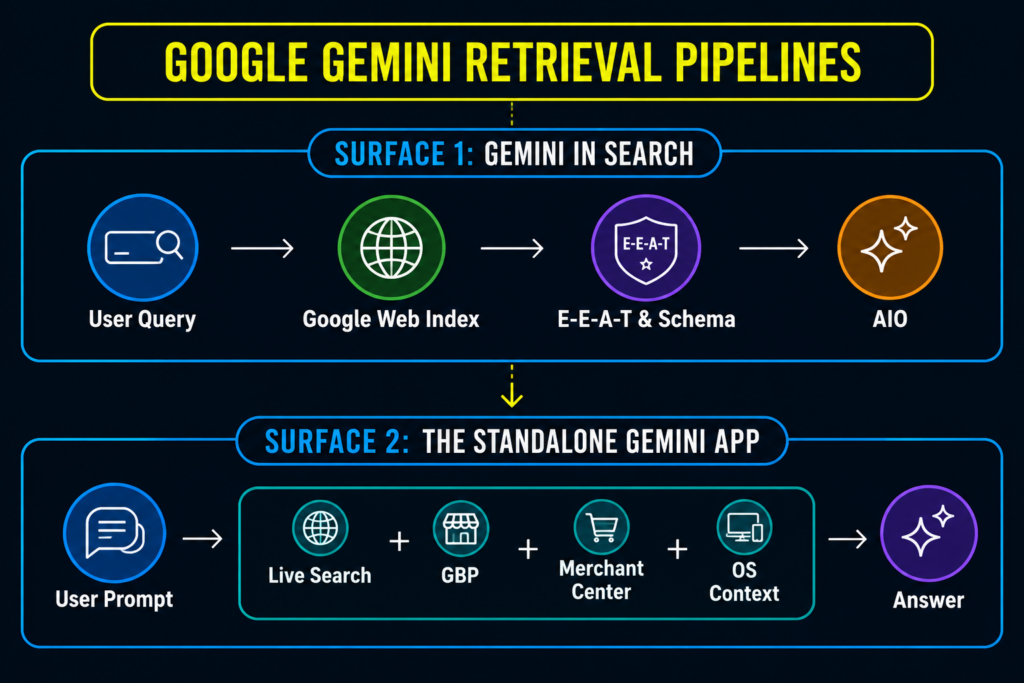
Executive Summary: Google Gemini operates across two distinct digital surfaces that require separate Generative Engine Optimization (GEO) strategies. Gemini in Search (AI Overviews and AI Mode) relies on Google’s traditional web crawl, page authority, and structured HTML schema. The Standalone Gemini App operates as an ambient assistant across Android, Workspace, and Chrome, blending live web retrieval with Google Business Profiles, review volume, and first-party brand consistency.
Key Takeaways
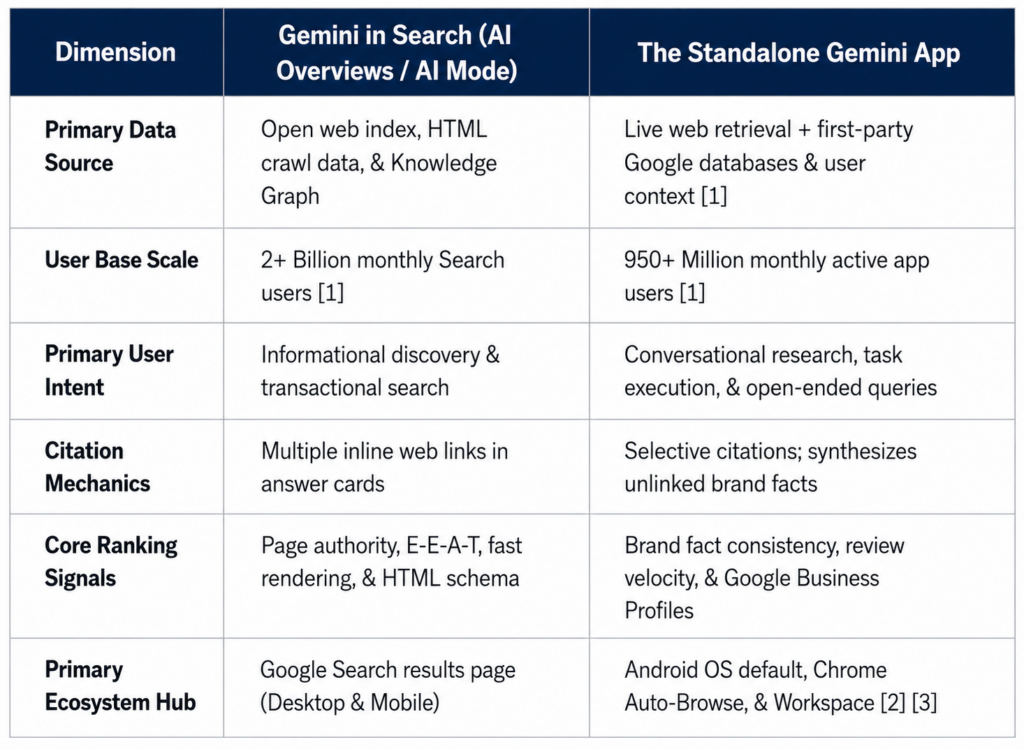
- Two Distinct Environments: Gemini in Search evaluates traditional open-web SEO signals, while the Gemini App evaluates blended first-party entity signals (Google Business Profiles, review velocity, ecosystem data) [¹].
- Massive User Scale: The Gemini app reached 950 million monthly active users in 2026 [¹], while Gemini-powered AI Overviews reach over 2 billion global users inside Google Search [¹].
- Ambient OS Integration: Google is sun-setting legacy Google Assistant on Android devices in favor of Gemini [²], turning every mobile voice interaction into a Gemini retrieval moment.
- In-Browser Execution: Gemini in Chrome introduces “Auto-Browse” capabilities, summarizing open web tabs and navigating checkout funnels directly within the user’s browser [³].
- Cluster Depth Over Thin Content: Both surfaces reward interlinked, comprehensive content hubs rather than bloated, single-page articles that get compressed into uncited paragraphs.
What’s the Difference Between Gemini in Search and the Gemini App?
Gemini in Search and the Gemini App share Google’s underlying multimodal model family, but they serve different user intents, retrieve data from different pipelines, and display citations differently.
1. Gemini in Search (AI Overviews & AI Mode)
Gemini in Search functions as an extension of Google’s core web crawler. When users execute queries on google.com, the model synthesizes answers using indexed web pages, ranking signals, E-E-A-T (Experience, Expertise, Authoritativeness, Trustworthiness), and structured data schema.
2. The Standalone Gemini App
The Gemini App functions as an AI assistant accessible via mobile apps, web interfaces, and system-level integrations. Rather than relying solely on live web crawls, the Gemini App synthesizes answers by combining live web lookups with user context, conversational memory, and Google’s first-party entity databases (Google Business Profiles, Google Maps, Google Shopping, Google Workspace data) [¹].
Gemini in Search vs. The Gemini App: Side-by-Side Comparison
Why Treating “Google AI” as One Channel Fails
Google’s unified branding encourages marketers to view Gemini as a single product. However, treating Gemini in Search and the Gemini App as identical leads to critical optimization gaps:
- Incomplete Audits: Evaluating visibility strictly within Search AI Overviews misses the 950 million users asking buying and comparison questions directly inside the Gemini App [¹].
- Disconnected Data Sources: A website that ranks in AI Overviews can still be omitted by the Gemini App if its Google Business Profile, review metadata, or merchant feeds contain conflicting brand information.
- Different Buying Intent: Search users look for immediate answers, whereas Gemini App users engage in multi-turn research, document analysis, and conversational evaluation.
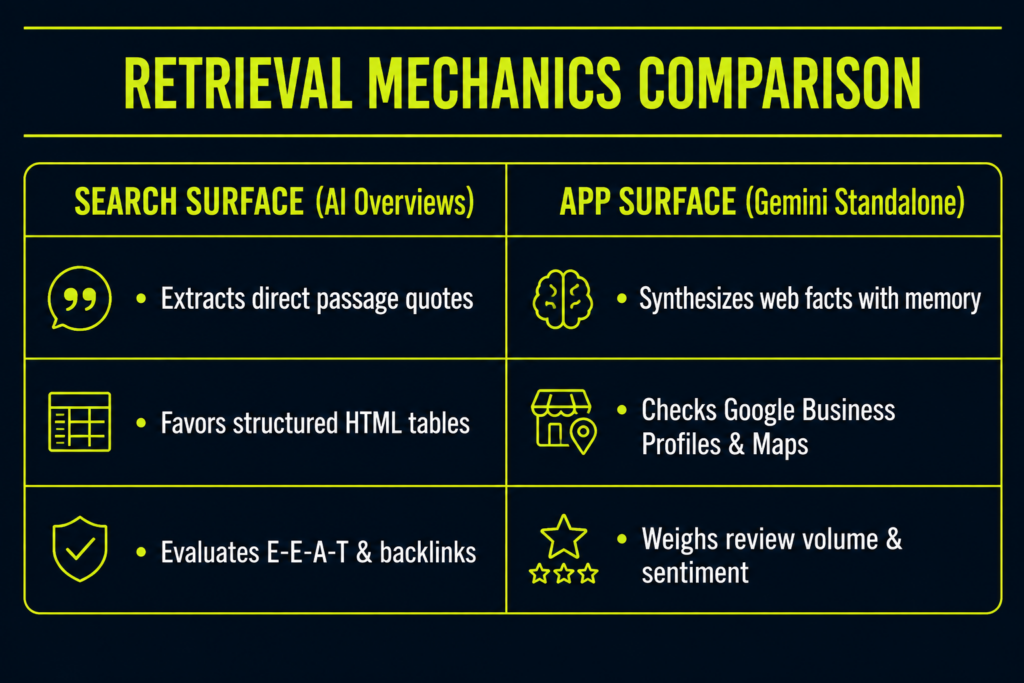
Retrieval Mechanics: Search vs. App
Understanding how each surface extracts information determines how you format content.
Retrieval in Gemini in Search
AI Overviews pull concise, direct answers from top-ranking organic pages. AI Mode conducts multi-turn retrieval, synthesizing information from multiple interlinked pages within a domain. Both interfaces prioritize technical SEO, fast page speeds, structured JSON-LD schema, and clear direct-answer lead paragraphs.
For a detailed breakdown of Search interfaces, read our guide on Google AI Mode vs. AI Overviews.
Retrieval in the Standalone Gemini App
When users prompt the Gemini App for product recommendations or brand comparisons, the model combines live web browsing with pre-existing entity knowledge.
- Google Business Profile Integration: Physical locations, product categories, operating hours, and verified business details feed directly into the model.
- Review Volume & Sentiment: Unstructured sentiment across Google Reviews, Reddit, and third-party review sites informs brand recommendation logic.
- Cross-Web Fact Consistency: Variations in pricing, product specifications, or founding details across web mentions degrade the model’s confidence, causing it to favor competitors with consistent web data.
To see how Gemini compares to other AI engines, explore our analysis on AI search engines compared.
The Ambient Distribution Advantage: Android, Workspace, and Chrome
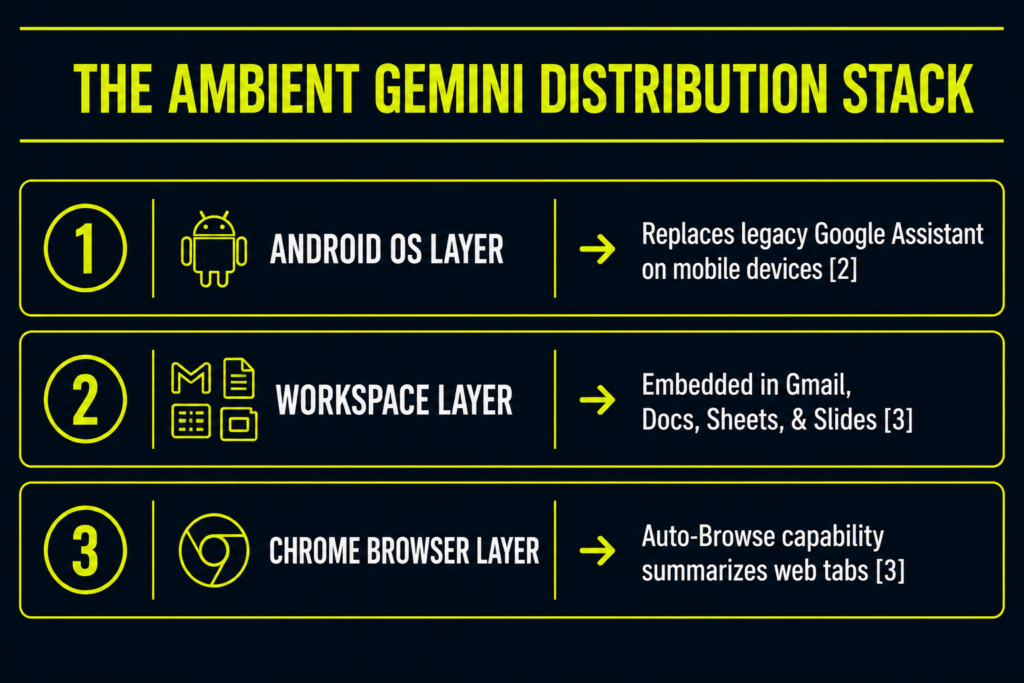
The growth of the Gemini App is driven by its native integration across Google’s software ecosystem.
1. Android OS Layer
Google is sun-setting Google Assistant on Android devices in favor of Gemini [²]. This transition establishes Gemini as the default assistant on billions of mobile devices [²], converting voice commands into Gemini retrieval prompts.
2. Google Workspace Layer
Gemini is integrated directly into Gmail, Docs, Sheets, and Slides [³]. It analyzes business documents, summarizes product proposals, and answers workplace queries using corporate and public web data.
3. Chrome Browser Layer (“Auto-Browse”)
Gemini in Chrome provides an AI layer capable of reading web pages in real time, summarizing open tabs, and executing multi-tab tasks using “Auto-Browse” capabilities [³]. Your website content must be clear enough to survive real-time AI summarization while a user views your page.
5 Common GEO Mistakes to Avoid
- Mistake 1: Assuming Search AI Visibility Covers the Gemini App: Ranking in AI Overviews does not guarantee visibility inside the standalone Gemini App.
- Mistake 2: Relying Solely on Search Console Screenshots: Google Search Console tracks Search data, but supplies zero visibility into standalone Gemini App queries.
- Mistake 3: Treating Google Business Profile as Local-Only: E-commerce and national brands must maintain Google Business Profiles, as they serve as a core first-party data source for the Gemini model.
- Mistake 4: Relying on Single 5,000-Word Mega-Guides: Single long-form articles often get compressed into uncredited summaries. Building a hub of interlinked, focused pages provides distinct passages for AI models to cite.
- Mistake 5: Allowing Inconsistent Brand Facts to Persist: Discrepancies in pricing, specifications, or company details across third-party sites lower model confidence scores.
Your 30-Day Gemini GEO Action Plan
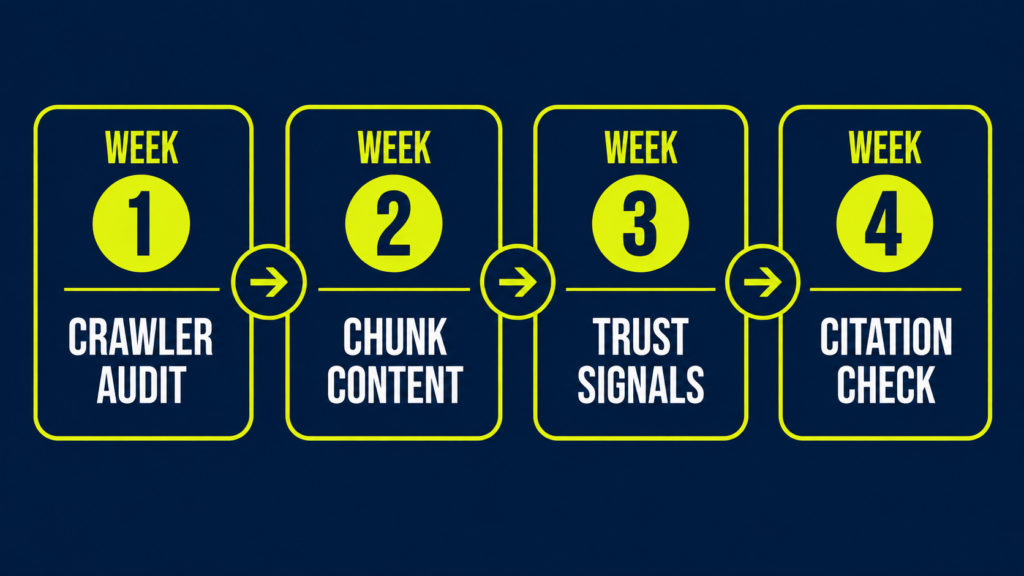
Week 1: Conduct Dual-Surface Audits
- Run 20 to 30 commercial queries through Google Search, logging AI Overview and AI Mode appearances.
- Run the same queries through the standalone Gemini App (web and mobile).
- Document differences in brand inclusion, citation links, and factual accuracy between the two surfaces.
Week 2: Audit First-Party Entity Foundations
- Update and verify your Google Business Profile profile data.
- Validate Product, Offer, Organization, and Review JSON-LD schema across target pages.
- Standardize pricing, specifications, and brand claims across your website, Google Merchant Center, and third-party directories.
Week 3: Build Citation-Targeted Content Hubs
- Identify commercial comparison queries where competitors appear in Gemini outputs.
- Publish focused, high-authority content pages featuring direct-answer lead sections (under 50 words) and structured data tables.
- Claim and verify your domain in Bing Webmaster Tools, as multiple AI platforms draw on Bing indexing pipelines.
Week 4: Test Real-Time Ambient Capabilities
- Test your website using Gemini in Chrome to evaluate how the browser summarizes your product pages [³].
- Audit brand sentiment across Reddit, YouTube reviews, and authority review sites that feed Gemini’s blended retrieval engine [¹].
- Establish a monthly monitoring schedule to track algorithm updates across both Gemini surfaces.
If you need a structured audit for your catalog, explore our specialized AI search optimization engagements.
Partner with National Positions for Advanced GEO
Optimizing for Google’s dual AI surfaces requires technical SEO, first-party data management, and generative content engineering.
National Positions provides complete Generative Engine Optimization solutions:
- 22+ Years of Growth Leadership: Managing digital search and performance strategies for over 300 e-commerce and SMB brands.
- Google Premier Partner Expertise: Deep specialization in Google Analytics 4, Search Console, and generative search environments.
- The PACE Framework: Our strategy (Plan, Analyze, Convert, Expand) grounds AI optimization in verified revenue growth.
- First-Party Attribution via AdBeacon: Our proprietary first-party attribution platform, AdBeacon, tracks customer touchpoints across search, social, and AI answer engines.
Ready to audit your brand’s visibility across AI Overviews and the Gemini App? Get in touch with National Positions to evaluate your current GEO baseline and build a dual-surface strategy.
Frequently Asked Questions
Is optimizing for Google AI Overviews the same as optimizing for the Gemini App?
No. AI Overviews pull directly from Google’s web index using traditional SEO signals and HTML schema. The Gemini App blends live web retrieval with Google Business Profiles, review metadata, user context, and first-party entity databases [¹].
Does the Gemini App cite sources as consistently as Perplexity or ChatGPT?
The Gemini App cites sources when executing live web retrieval passes. However, when answering from internal training data or blended knowledge, it provides synthesized answers without direct source links [¹].
How many people use the standalone Gemini App versus AI Overviews in Search?
The Gemini App reached 950 million monthly active users in 2026 [¹]. AI Overviews in Google Search reach over 2 billion global users monthly [¹].
Should e-commerce brands prioritize Gemini in Search or the Gemini App first?
Begin with Gemini in Search, as it aligns with existing SEO assets and drives direct search traffic. Then expand to the Gemini App to capture users interacting via Android, Chrome Auto-Browse, and Workspace integrations [²] [³].
How does Gemini in Chrome affect web content summarization?
Gemini in Chrome summarizes open web tabs and executes tasks across pages using Auto-Browse capabilities [³]. Content must feature clean structure and clear value propositions to survive real-time AI summarization.
What is the most common mistake brands make regarding Google Gemini?
Assuming a single audit covers all of “Google AI.” Managing Gemini requires separate strategies for Search AI Overviews and the standalone Gemini App [¹].
Sources & References
- Google News, “Google Gemini App Reaches 950 Million Monthly Active Users as AI Overviews Pass 2 Billion,” [¹].
- 9to5Google, “Google Assistant Shutting Down on Android and Wear OS in September 2026 as Gemini Takes Over,” Mobile Operating System Documentation (August 2026) [²].
- Google Workspace & Chrome Updates, “Gemini in Chrome Expands Auto-Browse Capabilities and Tab Context Integration,” Product Feature Documentation (2026) [³].
Related Deep-Dive Guides
- In-Search Generative Strategy: Read Google AI Mode vs. AI Overviews to master Google’s search interfaces.
- Multi-Engine AI Comparison: Read AI Search Engines Compared to see how Gemini compares against ChatGPT, Perplexity, and Claude.
- Cross-Engine Citation Tracking: Read How to Track AI Search Visibility Across Platforms to measure your brand’s AI share of voice.