
Executive Summary: Generative Engine Optimization (GEO) is the practice of optimizing digital content and brand entity signals so that artificial intelligence answer engines—such as ChatGPT, Google AI Overviews, Perplexity, and Gemini—include, cite, and recommend your business inside synthesized responses. Rather than competing for positions on a page of traditional blue links, GEO focuses on establishing machine-readable trust and extractable factual answers [¹] [²].
Key Takeaways
- Citations Over Rankings: GEO targets inclusion, brand citations, and product recommendations inside synthesized AI answers rather than traditional organic search engine result page (SERP) positions [¹].
- The 4-Stage AI Pipeline: To be cited in AI responses, content must pass four retrieval stages: Findable (crawled), Understandable (structured), Trustworthy (E-E-A-T verified), and Choosable (concise, extractable text) [¹] [³].
- Built on SEO Foundations: GEO builds upon technical SEO crawlability and indexation, but shifts focus toward E-E-A-T, sentence-level “chunkability,” co-citations, and entity consistency [²] [⁴].
- Primary Data Sources: Large Language Models (LLMs) draw heavily from core indices and entity graphs: Bing’s search index, Google’s Knowledge Graph, Wikipedia, Reddit discussions, and authoritative industry publishers [⁴] [⁵].
- Measurable Share of Voice: GEO success is tracked via prompt citation rates, Share of AI Voice across platforms, branded search volume lift, and AI referral traffic [³].
What Does GEO Actually Mean?
Generative Engine Optimization (GEO) encompasses the technical, structural, and authority-building strategies used to earn citations inside AI-generated answers.
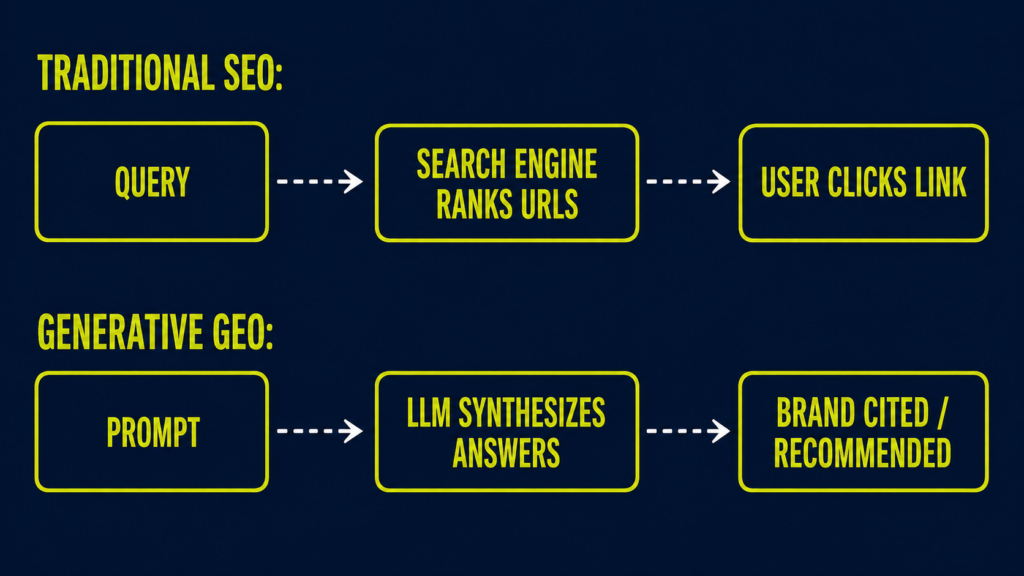
When a user prompts ChatGPT, Perplexity, or Google AI Overviews with a commercial question (e.g., “What is the best way to reduce cart abandonment for a DTC brand?”), the engine reads across multiple sources, synthesizes a single response, and attributes claims to specific brands or URLs [¹][³].
Winning in this environment requires three distinct levels of visibility:
- Brand Presence: The AI model recognizes your brand entity and associates it with your product category.
- Inline Citation: The AI engine appends a clickable link or footnote pointing directly to your URL as a source [¹].
- Product Recommendation: The AI engine actively recommends your business or software when users ask for top market solutions.
For a full breakdown of cross-platform tracking and a complete 90-day implementation roadmap, read our pillar guide, The Complete Guide to AI Search Visibility (GEO) in 2026.
How Does GEO Work? The 4-Stage AI Answer Pipeline
Most generative answer engines combine Retrieval-Augmented Generation (RAG) with large language model synthesis [³]. Content must successfully pass four distinct stages to earn a final citation [¹] [³]
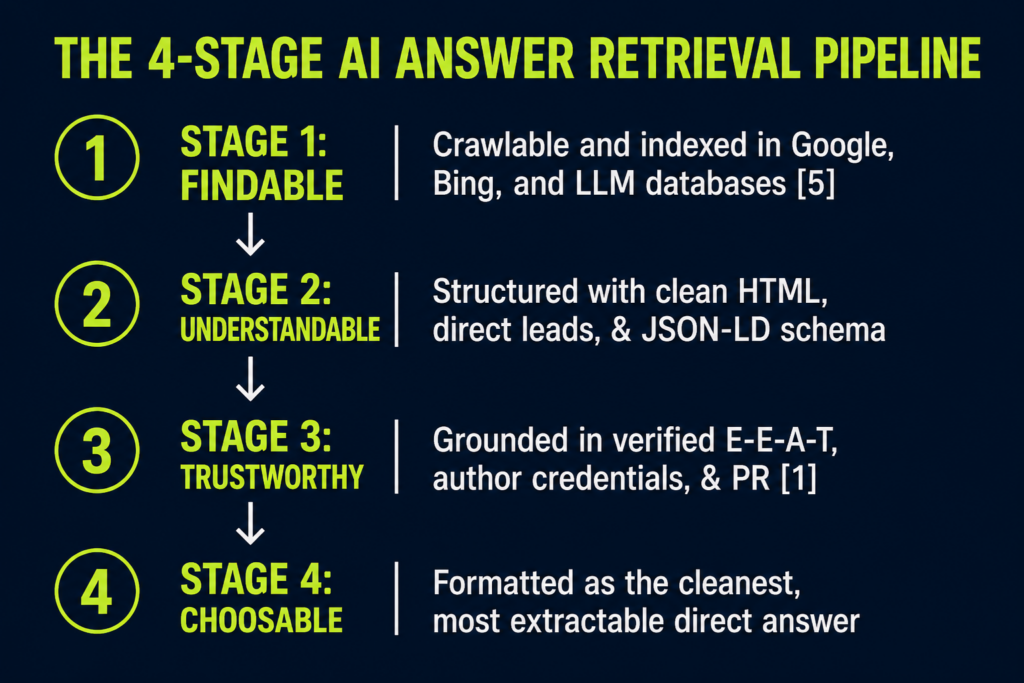
- Stage 1: Findable (Discovery & Indexation): The page must be crawled and indexed by core web crawlers (Googlebot, Bingbot) and permitted by AI retrieval crawlers (e.g., OAI-SearchBot, PerplexityBot) [⁵].
- Stage 2: Understandable (Machine Readability): Content must feature clear HTML subheadings (H2, H3), structured JSON-LD schema, and clear semantic context so parsers understand the core claims [³].
- Stage 3: Trustworthy (Authority Verification): The model checks domain authority, named author credentials, co-citations, and presence across high-trust data sources (Wikipedia, trade press) [¹] [⁴].
- Stage 4: Choosable (Extraction Quality): The model selects the concise, self-contained 40-to-60-word passage that directly answers the user prompt to generate an inline citation [¹].
GEO vs. SEO: What’s the Difference?
GEO does not replace SEO; it builds upon traditional technical SEO fundamentals to capture zero-click and conversational search discovery [²].
SEO vs. GEO Comparison Matrix
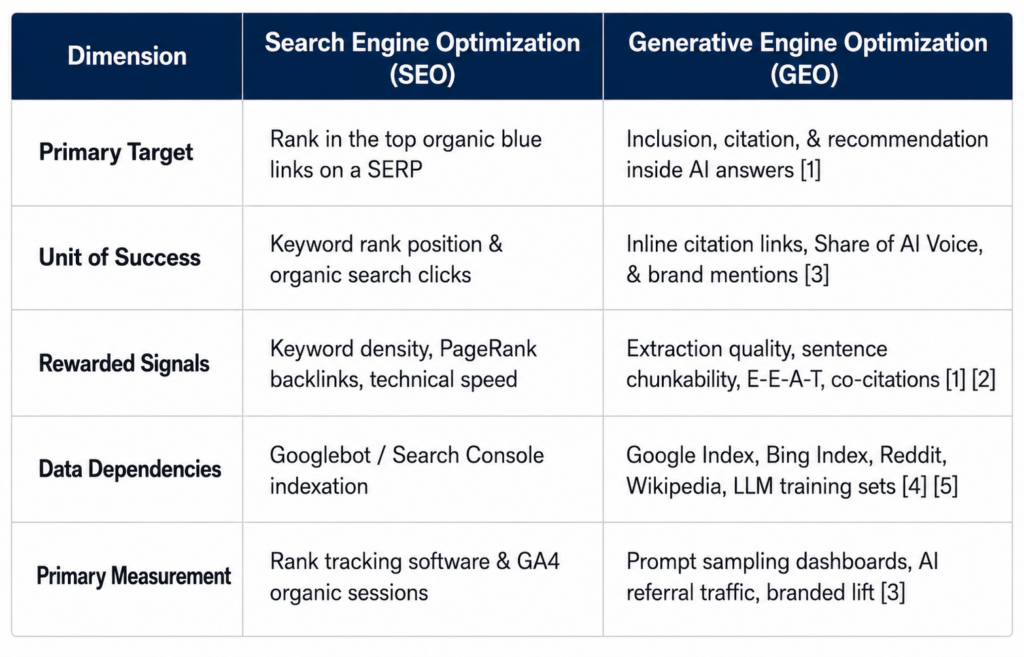
Rather than treating these as separate budgets, evolving your marketing strategy requires running integrated SEO and AI Search Optimization programs as a unified growth engine.
What Ranking and Citation Factors Do LLMs Weigh?
While individual AI models update their retrieval algorithms continuously, academic research and industry studies identify five core signals that consistently drive LLM citation selection [¹] [²] [³].
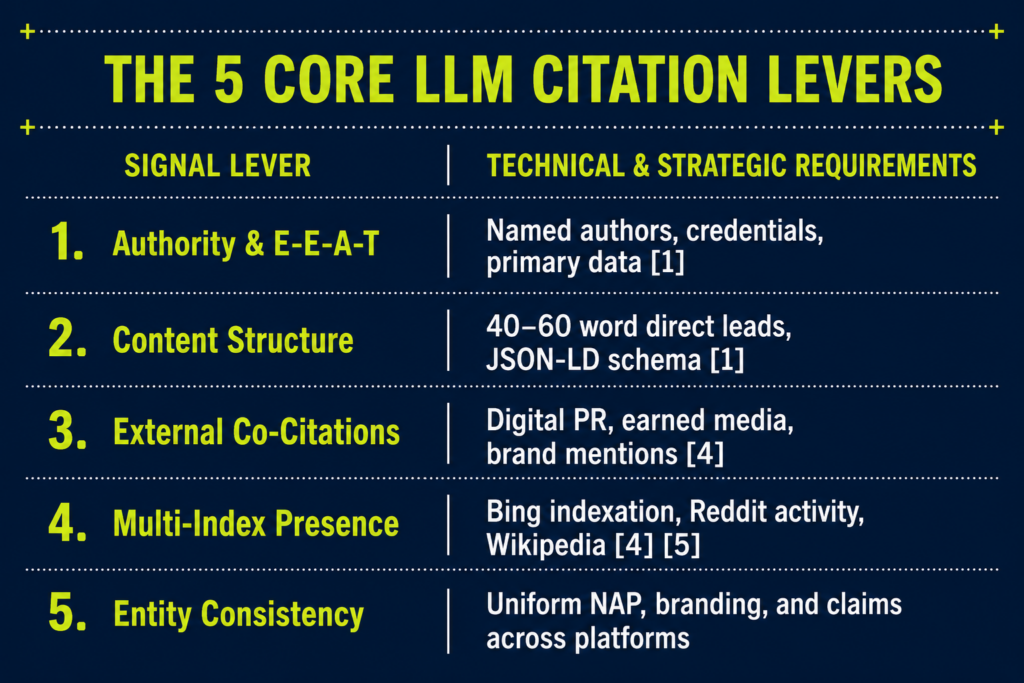
1. Authority and E-E-A-T (Experience, Expertise, Authoritativeness, Trust)
Models prioritize information from verified sources [¹]. Publishing content written by accredited experts, attaching complete author bios, including primary case studies, and referencing peer-reviewed data significantly increases model selection odds [¹].
2. Content Structure and Chunkability
RAG systems process text in sentence-level chunks. Placing concise 40-to-60-word direct answers immediately below query-based subheadings allows parsers to extract factual claims cleanly [¹] [³].
3. External Co-Citations and Digital PR
LLMs evaluate brand credibility by analyzing mentions across third-party websites [⁴]. Earning coverage in major industry publications, trade news sites, and authoritative blogs establishes the co-citations required for LLM trust [⁴]. Explore our PR and AI Visibility solutions to build off-site authority.
4. Presence Across Core AI Input Feeds
AI search engines rely heavily on specific data hubs:
- Bing Search Index: Powers real-time search retrieval for ChatGPT, Microsoft Copilot, and Meta AI [⁵].
- Reddit & Industry Forums: Indexed continuously by LLMs for authentic user experiences and product reviews [⁴].
- Wikipedia & Wikidata: Serves as a primary entity grounding database for LLMs and Knowledge Graphs [¹].
5. Entity Consistency and Content Freshness
Maintaining uniform business details (name, services, product specs, pricing) across all web properties eliminates factual ambiguity. Furthermore, regularly updating core landing pages provides the recency signals favored by live-retrieval AI engines [³].
4 Outdated SEO Habits to Stop Immediately
- Publishing Thin, Keyword-Stuffed Content: LLMs easily summarize basic topic overviews without citing generic articles [¹]. Focus content on unique data, proprietary survey results, and expert analysis.
- Attempting Manipulative “Prompt-Injection” Tricks: Injecting hidden text or manipulative schema instructions damages domain trust and risks automated filter penalties [¹].
- Publishing Anonymous, Unattributed Articles: Content lacking verified author credentials signals low E-E-A-T to search parsers, causing LLMs to cite accredited competitors [¹].
- Ignoring Non-Google Index Pipelines: Overlooking Bing Webmaster Tools or community discussions isolates your brand from the search pipelines powering ChatGPT, Copilot, and Meta AI [⁴] [⁵].
A Starter GEO Framework You Can Run This Quarter
Implement this 4-step framework—aligned with our PACE methodology (Plan, Analyze, Convert, Expand)—to establish a structured GEO workflow.
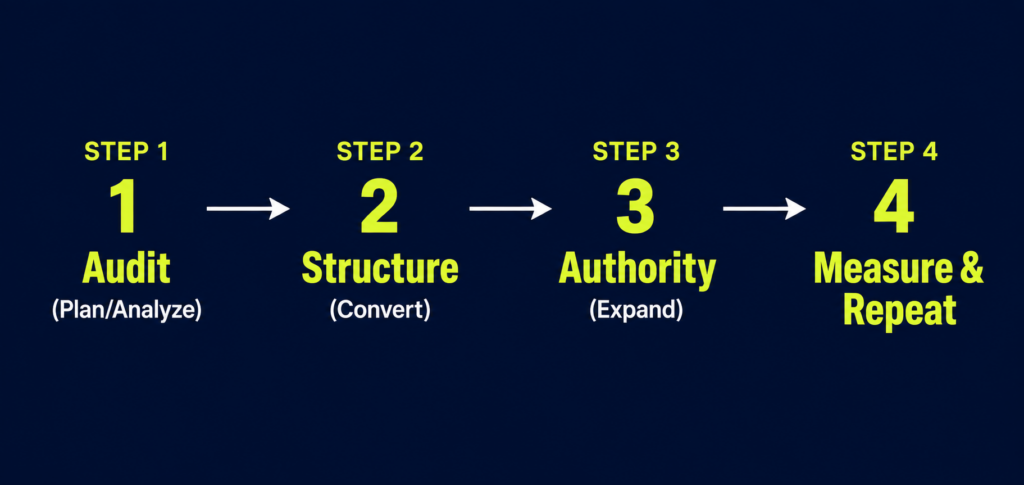
Step 1: Audit Your AI Presence (Plan & Analyze)
- Select 20 to 40 high-intent customer prompts.
- Query ChatGPT, Google AI Overviews, Perplexity, and Gemini manually or via automated trackers, recording brand inclusion, competitor citations, and factual accuracy [³].
- Verify domain indexation in Bing Webmaster Tools and ensure robots.txt rules allow AI search crawlers (OAI-SearchBot, PerplexityBot) [5].
Step 2: Make Your Content Citable (Convert)
- Restructure core landing pages to lead with a direct 40-to-60-word answer within the first two sentences of major sections [¹].
- Add structured FAQPage, Article, Organization, and Product JSON-LD schema.
- Attach verified expert author credentials and primary data points to high-priority articles [¹].
Step 3: Build Off-Site Authority (Expand)
- Execute digital PR outreach to secure brand citations in authoritative trade publications [⁴].
- Participate authentically in Reddit discussions and community forums relevant to your product category [⁴].
- Publish original research or industry benchmark studies that serve as citable primary sources [¹].
Step 4: Measure and Repeat
- Monitor Share of AI Voice, prompt citation frequency, and incoming AI referral traffic monthly [³].
- Refine underperforming pages based on competitive citation analyses.
Connecting top-of-funnel AI discovery touchpoints to closed revenue is why we developed our first-party attribution platform, AdBeacon, giving marketing leaders clear revenue visibility across all search channels.
Partner with National Positions for Advanced GEO
Winning citations across ChatGPT, Perplexity, Google AI Overviews, and Copilot requires integrated analytics engineering, digital PR, and technical content structuring.
National Positions provides complete Generative Engine Optimization solutions:
- 22+ Years of Search Engine Leadership: Managing digital search and performance analytics for over 300 e-commerce and B2B brands.
- Google Premier Partner Leadership: Recognized in the top tier of performance marketing agencies globally.
- The PACE Framework: Our methodology (Plan, Analyze, Convert, Expand) grounds AI search strategies in verified revenue metrics.
- First-Party Attribution via AdBeacon: Our proprietary first-party attribution platform, AdBeacon, measures traffic, attribution, and conversion impact across paid, organic, and AI-driven channels.
Ready to audit your brand’s AI search visibility? Book a call with our team to evaluate your current citation baseline and build a platform-specific GEO strategy.
Frequently Asked Questions
Is Generative Engine Optimization (GEO) the same as SEO?
No, though they share core technical foundations [²]. SEO optimizes web pages to rank in organic blue-link results pages. GEO optimizes content structure and entity authority so AI answer engines cite and recommend your brand inside synthesized responses [¹] [³].
How can a brand get cited by ChatGPT or Google AI Overviews?
Ensure your domain is indexed in Bing and Google [⁵], place direct 40-to-60-word answers beneath clear subheadings [¹], attach accredited author bios [¹], and build co-citations across digital PR outlets, Reddit, and Wikipedia [⁴].
Does GEO work for small businesses or only enterprise brands?
GEO works effectively for businesses of all sizes. While enterprise brands possess established domain authority, smaller businesses can capture citations by publishing highly specialized, data-dense content that directly answers niche long-tail queries [¹].
How long does it take to see results from a GEO strategy?
Structural updates (schema, clear lead sentences, Bing indexation) can yield citation improvements within 30 to 60 days [¹] [⁵]. Compounding authority gains from digital PR and original research accrue over 6 to 12 months [⁴].
Do businesses still need traditional SEO if they invest in GEO?
Yes. AI answer engines rely on traditional web crawlers to discover and index content [³] [⁵]. Solid technical SEO forms the mandatory foundation upon which GEO operates.
Sources & References
- Academic Research Disclosures, “Generative Engine Optimization (GEO): Structuring Content for Large Language Model Retrieval,” Academic Benchmark Study on LLM Citation Mechanics [¹].
- Google Search Central, “Guidance on AI Overviews, Helpful Content, and E-E-A-T Frameworks,” Technical Webmaster Guidelines [²].
- Search Engine Analytics Studies, “Generative Engine Retrieval Benchmarks & Multi-Engine Citation Volatility,” Industry Search Analytics [³].
- Digital PR & Authority Benchmarks, “Co-Citation Analysis, Social Graph Indexing, and LLM Grounding Sources,” Industry Analytics Reports [⁴].
- Microsoft Bing Webmaster Documentation, “Bing Web Indexing Architecture and Retrieval Roles in Generative AI Search,” Technical Webmaster Documentation [⁵].