
Executive Summary: Meta AI operates as a conversational search and recommendation engine across Instagram, Facebook, WhatsApp, and Messenger. Unlike web-crawling search engines, Meta AI retrieves answers primarily from closed social graphs, structured product catalogs, business page metadata, and Bing web search. Optimizing for Meta AI requires treating social assets as structured index data rather than purely engagement channels.
Key Takeaways
- Unprecedented Scale: Meta AI reached over 1 billion monthly active users [¹], embedded directly inside Instagram DMs, Facebook Feed, Messenger, and WhatsApp.
- Social Graph Indexing: While traditional SEO targets web crawlers, Meta AI draws heavily on public Facebook Pages, Instagram Shopping catalogs, WhatsApp Business profiles, public Group discussions, and user-generated reviews [²].
- Native E-Commerce Integration: Meta AI accesses first-party transactional data, star ratings, and product catalog metadata natively, allowing it to perform direct product recommendations inside active chat threads [²].
- Passive Search Behavior: Users query Meta AI without leaving social apps, creating a zero-click discovery environment where brand citations happen inside conversational threads.
- Catalog Hygiene is Mandatory: Outdated prices, missing product descriptions, or inactive business pages directly exclude brands from Meta AI recommendation outputs [²].
Is Meta AI Actually a Search Engine?
Meta AI functions as a conversational search engine embedded across Meta’s ecosystem. When users enter prompts like “what’s a good running shoe for flat feet” or “where should I eat in Silver Lake tonight,” Meta AI synthesizes answers using its Llama model family, public content across Meta’s social graph, structured commerce databases, and live web results supplied by Bing [²].
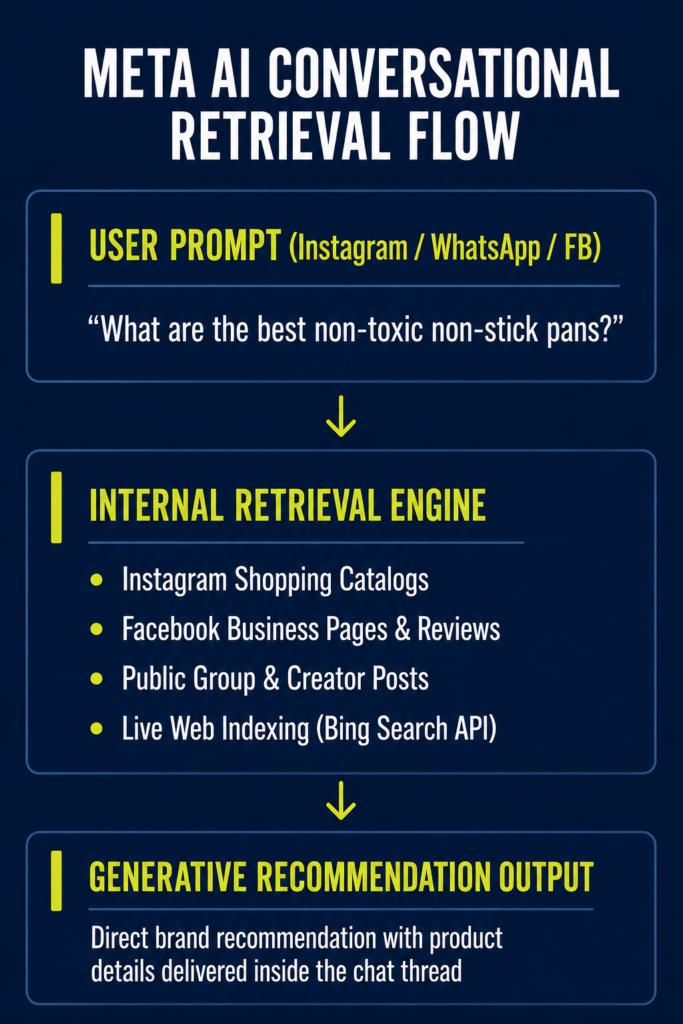
With Meta AI crossing 1 billion monthly active users [¹], discovery occurs directly inside the habit loop of billions of daily active users. When an Instagram user sees a product in a Story and asks Meta AI “is this worth the money,” the recommendation happens entirely within the app. No session records in standard web analytics, and no query registers in Google Search Console, yet a purchase decision is made.
How Meta AI Differs From Google, ChatGPT, and Perplexity
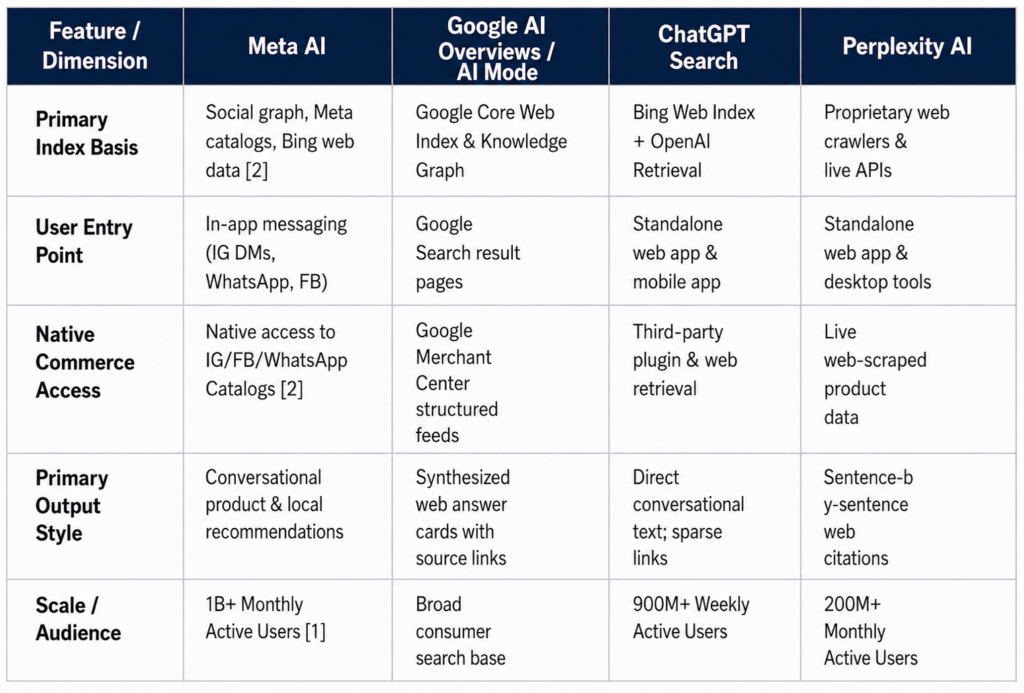
Optimizing for Meta AI requires recognizing how its retrieval architecture differs from traditional search engines and web-based AI answer engines.
Comparison: Meta AI vs. Traditional & Generative Search Engines
Key Takeaways
- Unprecedented Scale: Meta AI reached over 1 billion monthly active users [¹], embedded directly inside Instagram DMs, Facebook Feed, Messenger, and WhatsApp.
- Social Graph Indexing: While traditional SEO targets web crawlers, Meta AI draws heavily on public Facebook Pages, Instagram Shopping catalogs, WhatsApp Business profiles, public Group discussions, and user-generated reviews [²].
- Native E-Commerce Integration: Meta AI accesses first-party transactional data, star ratings, and product catalog metadata natively, allowing it to perform direct product recommendations inside active chat threads [²].
- Passive Search Behavior: Users query Meta AI without leaving social apps, creating a zero-click discovery environment where brand citations happen inside conversational threads.
- Catalog Hygiene is Mandatory: Outdated prices, missing product descriptions, or inactive business pages directly exclude brands from Meta AI recommendation outputs [²].
Is Meta AI Actually a Search Engine?
Meta AI functions as a conversational search engine embedded across Meta’s ecosystem. When users enter prompts like “what’s a good running shoe for flat feet” or “where should I eat in Silver Lake tonight,” Meta AI synthesizes answers using its Llama model family, public content across Meta’s social graph, structured commerce databases, and live web results supplied by Bing [²].
What Counts as a GEO Input Inside Meta’s Ecosystem?
Generative Engine Optimization (GEO) inside Meta’s ecosystem relies on structured, public social assets rather than standard website HTML alone.
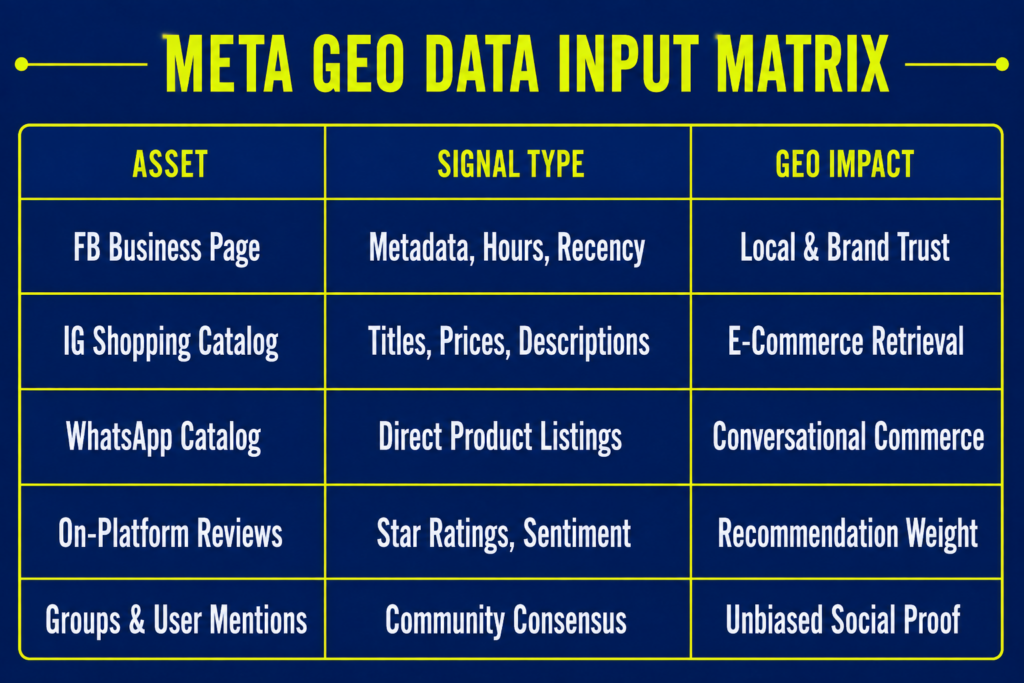
Core Meta GEO Assets:
- Facebook Business Page Metadata: Fully completed profiles, verified business status, accurate category tagging, physical address, operating hours, and active post history.
- Instagram Shopping Catalog Feeds: Structured product titles, rich feature descriptions, current pricing, stock availability, and accurate product tagging across organic posts and Reels.
- WhatsApp Business Catalogs: Structured inventory feeds reachable inside conversational messaging threads where direct-to-consumer and international sales occur.
- On-Platform Ratings and Reviews: Star ratings, written feedback, and direct customer interactions across Facebook and Instagram pages.
- Community & Group Discussions: Brand mentions, organic recommendations, and category discussions across public Facebook Groups and post comment threads [²].
- Creator & User-Generated Content (UGC): Public Reels and posts that tag, mention, or demonstrate your products, providing authentic social proof signals for the AI model.
To see how social AI search fits into a broader multi-engine strategy, read our guide on AI search engines compared.
5 Common Mistakes That Destroy Meta AI Visibility
- Mistake 1: Leaving Business Pages Inactive: A Facebook Page without recent posts or with incorrect operating hours signals an inactive business, causing the AI model to recommend active competitors.
- Mistake 2: Neglecting WhatsApp Business Catalogs: Outdated pricing or unmaintained product lists in WhatsApp lead Meta AI to return inaccurate information or omit products entirely.
- Mistake 3: Focusing Exclusively on Top-of-Funnel Vanity Metrics: High engagement on meme content does not supply the structured product data or specific brand attributes needed for recommendation queries.
- Mistake 4: Treating Social Media as Disconnected from Search: Siloing social media management away from SEO prevents teams from optimizing social captions, catalog descriptions, and page metadata for generative AI retrieval.
- Mistake 5: Ignoring Attribution Gaps: Expecting standard Google Analytics referral traffic from Meta AI leads to false conclusions. Brands must track share-of-voice and branded search lift rather than relying on direct referral links.
A 30-Day Plan to Get Meta AI Ready
Follow this 4-week roadmap to structure your Meta social footprint for generative retrieval.
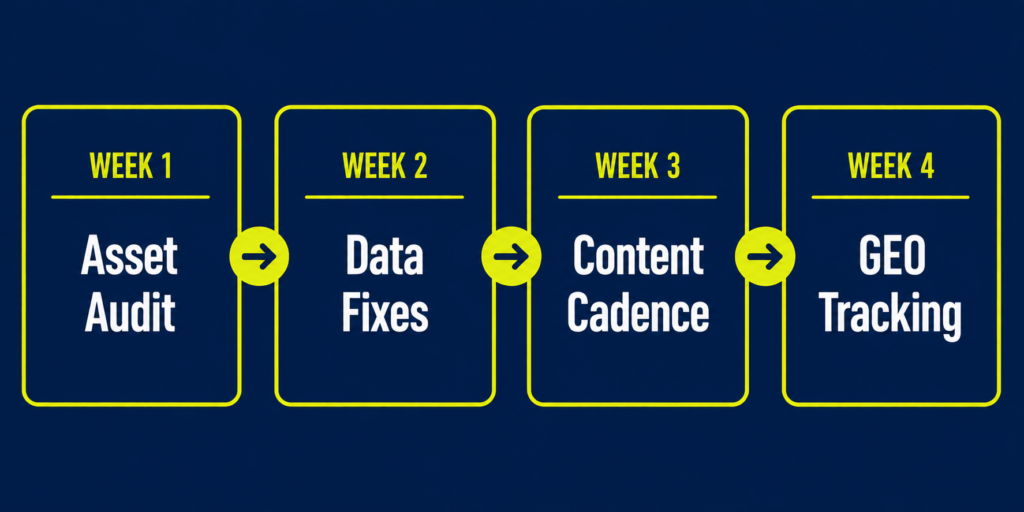
Week 1: Audit What Meta AI Currently Sees
- Audit your Facebook Business Page, Instagram Shopping account, and WhatsApp Business catalog for completeness.
- Test 10 to 15 category-specific buyer prompts inside Meta AI (e.g., “What are the best DTC skincare brands for sensitive skin?”).
- Document whether your brand appears, how competitors are cited, and what product details are returned.
Week 2: Resolve Structural Data & Catalog Gaps
- Update product titles, SKU descriptions, pricing, and category tags across Instagram and WhatsApp catalogs.
- Verify your Facebook Business Page and update operating hours, physical locations, and contact details.
- Ensure product tagging is active across recent Instagram posts and Reels.
Week 3: Establish a Machine-Readable Content & Review Cadence
- Publish consistent, descriptive public posts on Facebook and Instagram outlining specific product use cases, materials, and benefits.
- Implement an active response strategy for customer reviews and post comments.
- Participate authentically in public Facebook Groups relevant to your industry vertical.
Week 4: Deploy GEO Monitoring & Multi-Platform Integration
- Re-run your Week 1 benchmark prompts in Meta AI to measure changes in brand inclusion and accuracy.
- Integrate Meta AI monitoring into your broader search tracking framework. Learn how to track social AI presence in our guide on tracking AI search visibility across platforms.
How to Get Recommended by Meta AI
Meta AI prioritizes brands that demonstrate high structured data clarity, active social proof, and current platform activity [²].
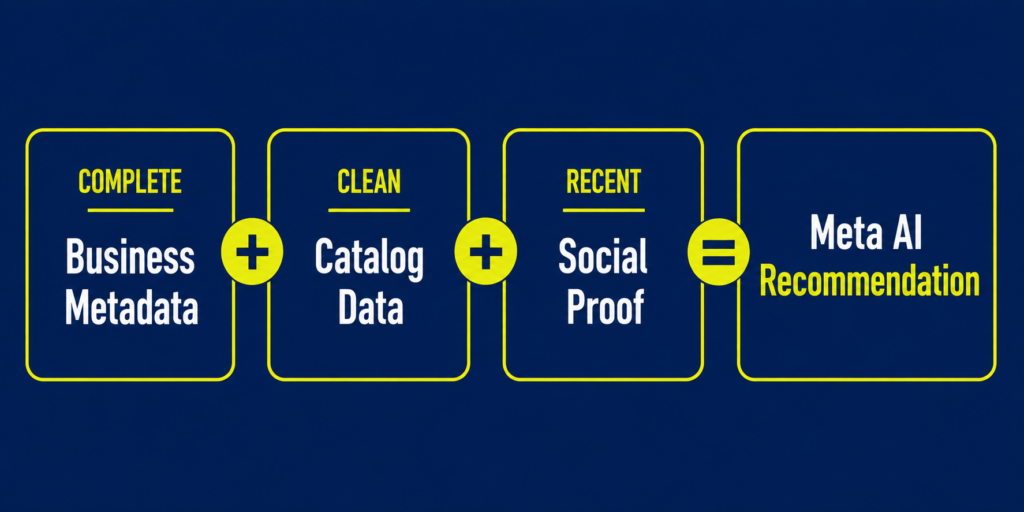
- Maintain Complete Structured Profiles: Fill out every available field on Meta business profiles, ensuring consistency across Facebook, Instagram, and WhatsApp.
- Optimize Catalog Descriptions for Intent: Write product descriptions that explicitly answer customer purchase questions (e.g., fit, materials, care instructions, compatibility).
- Encourage Native Reviews: Actively collect customer reviews on Facebook and Instagram, as on-platform sentiment directly influences AI recommendations.
- Publish Descriptive Caption Copy: Ensure post captions clearly describe product features and use cases, providing context for social graph indexers.
Partner with National Positions for Advanced GEO Implementation
Optimizing for generative search across Google, ChatGPT, Perplexity, and Meta AI requires unified data management and cross-platform technical expertise.
National Positions provides complete Generative Engine Optimization solutions:
- 22+ Years of Performance Growth: Managing digital search and social strategies for over 300 e-commerce and SMB brands.
- Google Premier Partner Leadership: Recognized in the top tier of performance marketing agencies worldwide.
- The PACE Methodology: Our integrated strategy (Plan, Analyze, Convert, Expand) grounds AI optimization in verified business revenue.
- First-Party Attribution via AdBeacon: Our proprietary first-party attribution platform, AdBeacon, connects fragmented social discovery touchpoints to backend sales data, ensuring complete visibility across the customer journey.
Ready to audit your brand’s visibility across Meta AI, ChatGPT, and Google AI Overviews? Book a consult with National Positions to evaluate your current GEO baseline and build a platform-specific optimization strategy.
Frequently Asked Questions
Is Meta AI the same thing as Meta AI Mode inside Facebook search?
Meta AI is the overarching assistant accessible across Instagram, WhatsApp, Messenger, and Facebook. Meta AI Mode refers specifically to AI-powered search features within Facebook that synthesize answers using public posts, Groups, business profiles, and web data [²].
Does Meta AI use private WhatsApp messages to generate brand recommendations?
No. Public reporting confirms that Meta AI mode and conversational recommendations rely on public content: public posts, Facebook Business Pages, Instagram Shopping catalogs, and public Group discussions [²]. It does not index private personal messages.
Is running paid ads on Meta required to appear in Meta AI recommendations?
No. Organic catalog quality, business page metadata, reviews, and public post context form the baseline for Meta AI recommendations [²]. However, active paid campaigns can amplify overall brand presence across Meta’s social graph.
How can a business track whether Meta AI is recommending its products?
Because Meta does not currently offer a dedicated webmaster dashboard for Meta AI, tracking requires manual prompt sampling or third-party AI visibility tools. Query Meta AI directly using high-intent product prompts and log brand share-of-voice over time.
Should an e-commerce brand prioritize Meta AI optimization over ChatGPT or Google AI Overviews?
Meta AI optimization should complement, not replace, Google and ChatGPT search strategies. E-commerce and consumer brands must maintain visibility across all primary discovery channels where their target audience searches for products.
Will Meta release explicit ranking guidelines for Meta AI?
Meta is unlikely to publish an exact algorithmic scoring key. Brands should focus on core data hygiene: maintaining accurate catalog feeds, generating authentic customer reviews, and publishing clear, descriptive social content.
Sources & References
- Meta Investor Relations, “Meta Reports Fourth Quarter and Full Year Financial Results,” Meta Investor Earnings Call Disclosures (2025–2026) [¹].
- Frase IO, “Generative Engine Optimization (GEO) in Closed Social Ecosystems,” Analysis of Meta AI Retrieval Infrastructure and Catalog Indexing (2025–2026) [²].
Related Deep-Dive Guides
- Cross-Platform AI Comparison: Read AI Search Engines Compared to see how Meta AI compares against Google, ChatGPT, and Perplexity.
- AI Visibility Tracking: Read How to Track AI Search Visibility Across Platforms to measure your brand’s AI share of voice.
- ChatGPT Strategy: Read The ChatGPT Search Playbook to master Bing-dependent search architectures.